Word Explanation
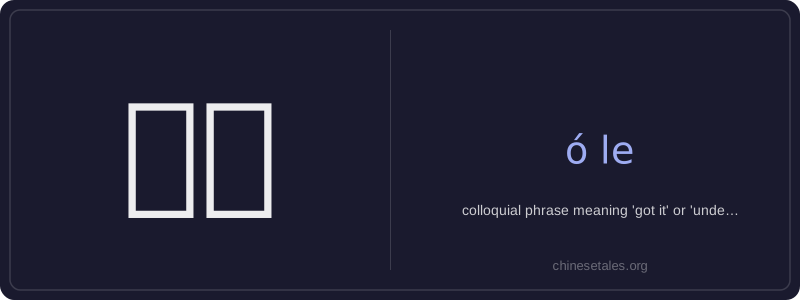
'Ó le' is a colloquial interjection used to signal sudden understanding or acknowledgment—equivalent to 'Got it!' or 'Ah, I see now!' in English. The character 哦 (ó) functions as an exclamatory particle expressing realization, while 了 (le) marks a change of state, together emphasizing that the speaker’s mental state has just shifted from confusion or uncertainty to comprehension. It’s commonly used in informal spoken Chinese, especially in face-to-face or phone conversations, and often appears at the beginning or end of a sentence.
This phrase carries a warm, responsive tone and is rarely written formally—it’s strongly tied to real-time interaction. Unlike formal equivalents like '明白了 (míngbái le)', 哦了 feels more spontaneous and conversational, sometimes even slightly playful or empathetic. It’s not used for complex explanations but works perfectly for quick confirmations after receiving instructions, clarifications, or reminders in everyday situations like work chats, family calls, or classroom exchanges.
Example Sentences
Related Words
国语
‘Guó yǔ’ literally means 'national language'—
无论谁
‘无论谁’ (wú lùn shéi) is a pronoun meaning
外语
‘外语’ literally means ‘outside language’ —
不对
不对 (bù duì) literally combines 不 (bù), meani
我的
我的 (wǒ de) is a possessive pronoun meaning 'my'
违规
违规 (wéi guī) literally means 'to violate rules
亲笔
‘亲笔’ literally means ‘one’s own hand’—comb
面条
‘面条’ (miàn tiáo) literally means ‘flour str