Word Explanation
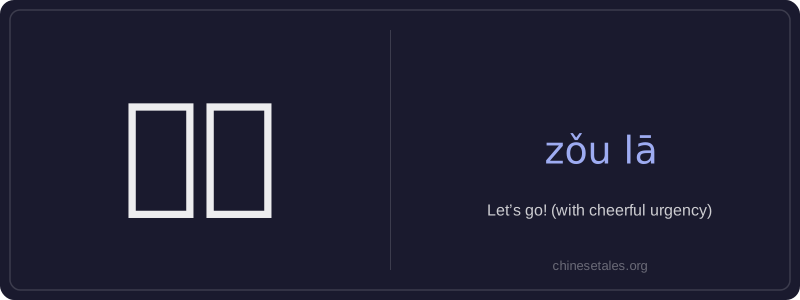
‘走啦’ is an informal, cheerful interjection used to urge someone (or a group) to depart or begin moving—often with friendly urgency or excitement. It combines the verb 走 (zǒu), meaning ‘to go’ or ‘to leave’, and the sentence-final particle 啦 (lā), which softens the tone and adds warmth, spontaneity, or light insistence. Unlike the more neutral ‘走了’ (zǒu le), ‘走啦’ carries a distinctly upbeat, encouraging, or playful vibe—like saying ‘Let’s go!’ rather than ‘We’re leaving.’
This phrase is commonly heard among friends, family, or colleagues when starting an outing, heading to class, catching transport, or wrapping up a casual gathering. It’s rarely used in formal settings or written communication; instead, it belongs to lively, spoken Chinese. The particle 啦 often signals shared understanding and positive intention—so ‘走啦’ feels inclusive and motivating, not commanding.
Example Sentences
Related Words
国语
‘Guó yǔ’ literally means 'national language'—
无论谁
‘无论谁’ (wú lùn shéi) is a pronoun meaning
外语
‘外语’ literally means ‘outside language’ —
不对
不对 (bù duì) literally combines 不 (bù), meani
我的
我的 (wǒ de) is a possessive pronoun meaning 'my'
违规
违规 (wéi guī) literally means 'to violate rules
亲笔
‘亲笔’ literally means ‘one’s own hand’—comb
面条
‘面条’ (miàn tiáo) literally means ‘flour str