Word Explanation
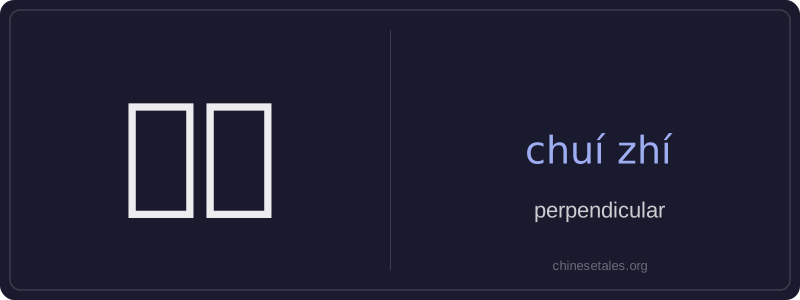
'垂直' (chuí zhí) literally combines '垂' (to hang down, to droop) and '直' (straight, direct), evoking the image of something hanging straight down like a plumb line — thus meaning 'perpendicular' in geometry and spatial contexts. It describes the precise 90-degree relationship between two lines, planes, or surfaces. Unlike general terms for 'upright' or 'vertical', 垂直 specifically emphasizes the orthogonal, right-angle orientation.
This word is commonly used in mathematics, engineering, architecture, and everyday descriptions of alignment — for example, when checking whether a wall is perfectly perpendicular to the floor or whether two roads intersect at right angles. It functions as an adjective before nouns (e.g., 垂直线 'perpendicular line') or after verbs like 是 or 成 (e.g., 这两条线是垂直的). It’s formal and technical but also appears in clear, practical contexts such as construction or design.
Example Sentences
Related Words
国语
‘Guó yǔ’ literally means 'national language'—
无论谁
‘无论谁’ (wú lùn shéi) is a pronoun meaning
外语
‘外语’ literally means ‘outside language’ —
不对
不对 (bù duì) literally combines 不 (bù), meani
我的
我的 (wǒ de) is a possessive pronoun meaning 'my'
违规
违规 (wéi guī) literally means 'to violate rules
亲笔
‘亲笔’ literally means ‘one’s own hand’—comb
面条
‘面条’ (miàn tiáo) literally means ‘flour str