Word Explanation
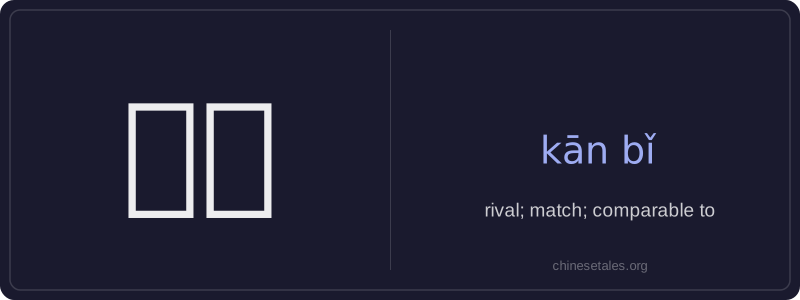
堪比 is a formal, literary verb meaning 'to rival', 'to match', or 'to be comparable to'. It combines 堪 (kān), meaning 'able to bear/withstand' or 'worthy of', and 比 (bǐ), meaning 'to compare'. Together, they convey the idea of being so exceptional that it stands on equal footing with something else — often something renowned or exemplary. It is not used for casual comparisons but emphasizes high-level equivalence, typically in written Chinese, formal speech, or descriptive commentary.
This expression frequently appears in evaluations of quality, beauty, skill, or natural phenomena — for instance, praising an animal’s grace as rivaling that of a mythical creature, or a performance matching world-class standards. It always takes the structure 'A 堪比 B', where A is the subject being elevated through comparison to B. The tone is positive and emphatic, implying admiration or astonishment at the degree of similarity or excellence.
Example Sentences
Related Words
国语
‘Guó yǔ’ literally means 'national language'—
无论谁
‘无论谁’ (wú lùn shéi) is a pronoun meaning
外语
‘外语’ literally means ‘outside language’ —
不对
不对 (bù duì) literally combines 不 (bù), meani
我的
我的 (wǒ de) is a possessive pronoun meaning 'my'
违规
违规 (wéi guī) literally means 'to violate rules
亲笔
‘亲笔’ literally means ‘one’s own hand’—comb
面条
‘面条’ (miàn tiáo) literally means ‘flour str