Word Explanation
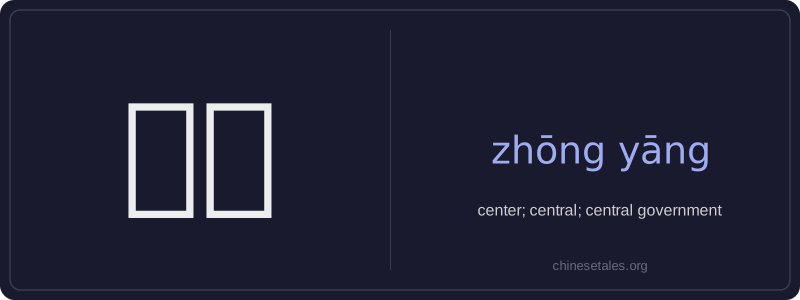
'中央' literally combines '中' (zhōng), meaning 'middle' or 'center', and '央' (yāng), which also means 'center' or 'core' — together they reinforce the idea of the very heart or central point of something. As a noun, it most commonly refers to the central government in China (e.g., the Central Committee of the Communist Party), but it can also denote the geographical center of a place, organization, or structure. It carries formal, often institutional weight and is rarely used for casual or physical descriptions of 'center' (where '中间' is preferred).
As an adjective, '中央' modifies nouns to indicate centrality in authority, location, or function — for example, '中央电视台' (China Central Television) or '中央公园' (Central Park). It implies official status, hierarchy, or structural importance rather than mere spatial positioning. The term appears frequently in political, administrative, urban planning, and media contexts, and its usage reflects top-down organizational logic common in Chinese institutional language.
Example Sentences
Related Words
国语
‘Guó yǔ’ literally means 'national language'—
无论谁
‘无论谁’ (wú lùn shéi) is a pronoun meaning
外语
‘外语’ literally means ‘outside language’ —
不对
不对 (bù duì) literally combines 不 (bù), meani
我的
我的 (wǒ de) is a possessive pronoun meaning 'my'
违规
违规 (wéi guī) literally means 'to violate rules
亲笔
‘亲笔’ literally means ‘one’s own hand’—comb
面条
‘面条’ (miàn tiáo) literally means ‘flour str