Word Explanation
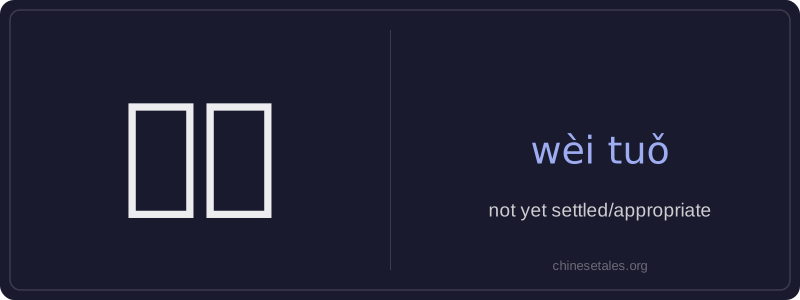
未妥 is an adjective meaning 'not yet settled,' 'not yet appropriate,' or 'not yet finalized.' It combines 未 (wèi), meaning 'not yet' or 'has not,' and 妥 (tuǒ), meaning 'proper,' 'appropriate,' or 'settled.' Together, they form a concise, formal expression indicating that something remains unresolved, unsuitable, or pending approval—often used in administrative, professional, or official contexts.
This term appears frequently in written Chinese, especially in emails, meeting minutes, official notices, or internal memos. It carries a neutral-to-formal register and is rarely used in casual speech. While grammatically it functions as an adjective, it typically follows the subject and precedes verbs like '处理' (handle) or '确定' (confirm), or appears after '尚' (still) to emphasize ongoing incompleteness—e.g., '尚欠妥' or '尚待未妥' (though the latter is redundant; '尚待妥当' is preferred). It conveys precision and restraint, fitting for contexts where diplomatic understatement is valued.
Example Sentences
Related Words
国语
‘Guó yǔ’ literally means 'national language'—
无论谁
‘无论谁’ (wú lùn shéi) is a pronoun meaning
外语
‘外语’ literally means ‘outside language’ —
不对
不对 (bù duì) literally combines 不 (bù), meani
我的
我的 (wǒ de) is a possessive pronoun meaning 'my'
违规
违规 (wéi guī) literally means 'to violate rules
亲笔
‘亲笔’ literally means ‘one’s own hand’—comb
面条
‘面条’ (miàn tiáo) literally means ‘flour str