Word Explanation
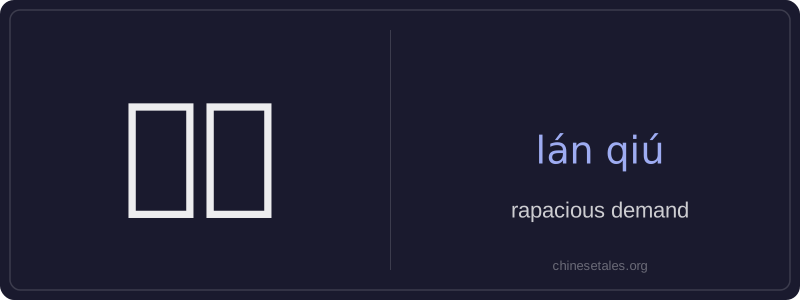
‘婪求’ is a literary noun meaning 'rapacious demand' or 'insatiable craving' — a greedy, excessive, and morally questionable desire for more than one needs or deserves. The first character 婪 (lán) means 'greedy' or 'voracious', often used in compounds like 贪婪 (tān lán, 'greed'); the second character 求 (qiú) means 'to seek' or 'to demand'. Together, they form a compact, slightly archaic term emphasizing uncontrolled, animal-like hunger — hence its association with the Animals topic, as it evokes imagery of ravenous beasts or predatory behavior.
This word appears primarily in formal writing, political commentary, or moral discourse to criticize exploitative behavior — such as unchecked corporate expansion, environmental plunder, or authoritarian overreach. It carries strong negative connotations and is rarely used in casual speech. Because it’s two-character and monosyllabic in rhythm (lán qiú), it often functions as a subject or object in complex sentences, frequently modified by adjectives like 狂妄的 (kuángwàng de, 'arrogant') or 无度的 (wúdù de, 'excessive').
Example Sentences
Related Words
国语
‘Guó yǔ’ literally means 'national language'—
无论谁
‘无论谁’ (wú lùn shéi) is a pronoun meaning
外语
‘外语’ literally means ‘outside language’ —
不对
不对 (bù duì) literally combines 不 (bù), meani
我的
我的 (wǒ de) is a possessive pronoun meaning 'my'
违规
违规 (wéi guī) literally means 'to violate rules
亲笔
‘亲笔’ literally means ‘one’s own hand’—comb
面条
‘面条’ (miàn tiáo) literally means ‘flour str