Word Explanation
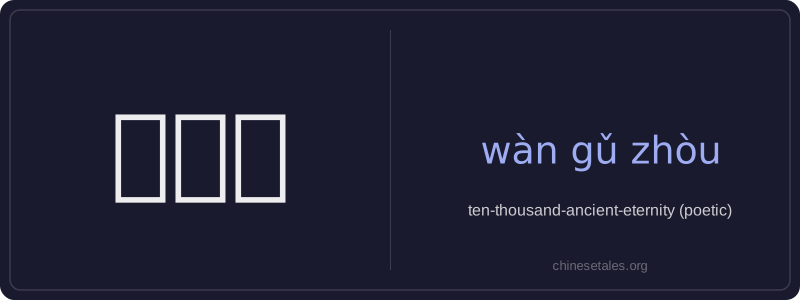
'Wàn gǔ zhòu' is a highly literary and poetic term meaning 'ten-thousand-ancient-eternity' — evoking an immeasurably vast, timeless span, far exceeding ordinary human conceptions of history or duration. It combines 万 (wàn, 'ten thousand', used hyperbolically for 'countless'), 古 (gǔ, 'ancient' or 'antiquity'), and 宙 (zhòu, 'universe' or 'cosmic time', as in 宇宙 yǔzhòu 'universe'). Unlike scientific terms like 地质年代 (dìzhì niándài, 'geologic time scale'), 万古宙 carries strong classical resonance, often appearing in poetry, philosophical texts, or rhetorical declarations to express enduring truth, eternal nature, or transcendent permanence.
This term is not used in daily conversation or technical contexts; it belongs exclusively to elevated, stylized language. Its rhythm and imagery recall classical Chinese cosmology, where time is cyclical and boundless. While it sounds like a formal geological era (e.g., eon), it has no official scientific definition in geology — it’s purely rhetorical and aesthetic, functioning more like 'time immemorial' or 'from the dawn of creation' in English.
Example Sentences
Related Words
国语
‘Guó yǔ’ literally means 'national language'—
无论谁
‘无论谁’ (wú lùn shéi) is a pronoun meaning
外语
‘外语’ literally means ‘outside language’ —
我的
我的 (wǒ de) is a possessive pronoun meaning 'my'
不对
不对 (bù duì) literally combines 不 (bù), meani
违规
违规 (wéi guī) literally means 'to violate rules
亲笔
‘亲笔’ literally means ‘one’s own hand’—comb
面条
‘面条’ (miàn tiáo) literally means ‘flour str