Word Explanation
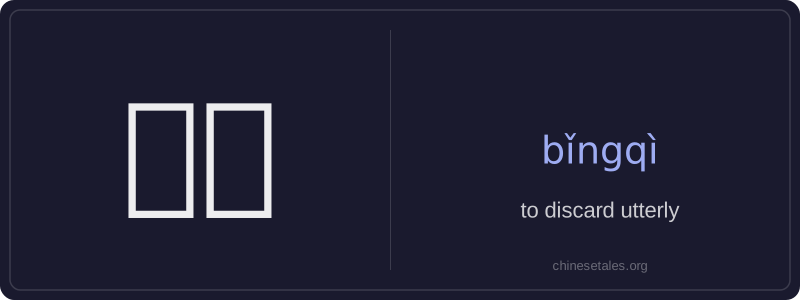
‘屏弃’ is a formal, literary verb meaning ‘to discard utterly’ or ‘to cast aside completely’, often implying a deliberate, resolute rejection of something undesirable—such as outdated ideas, harmful habits, or false beliefs. The first character 屏 (bǐng) means ‘to suppress’, ‘to hold back’, or ‘to shut out’, while 弃 (qì) means ‘to abandon’ or ‘to discard’. Together, they intensify the sense of total, conscious renunciation—not just letting go, but actively expelling or rejecting.
This word appears frequently in written Chinese: editorials, academic writing, policy documents, and moral exhortations. It carries a strong evaluative tone and is rarely used in casual speech. Unlike simpler synonyms like ‘扔掉’ (to throw away) or ‘丢掉’ (to lose/discard), ‘屏弃’ emphasizes ethical or intellectual judgment and often co-occurs with abstract nouns (e.g., ‘陈腐观念’, ‘错误思想’). It’s commonly paired with verbs like ‘坚决’ (resolutely) or ‘彻底’ (thoroughly) to reinforce its absoluteness.
Example Sentences
Related Words
国语
‘Guó yǔ’ literally means 'national language'—
无论谁
‘无论谁’ (wú lùn shéi) is a pronoun meaning
外语
‘外语’ literally means ‘outside language’ —
我的
我的 (wǒ de) is a possessive pronoun meaning 'my'
不对
不对 (bù duì) literally combines 不 (bù), meani
违规
违规 (wéi guī) literally means 'to violate rules
亲笔
‘亲笔’ literally means ‘one’s own hand’—comb
面条
‘面条’ (miàn tiáo) literally means ‘flour str