Word Explanation
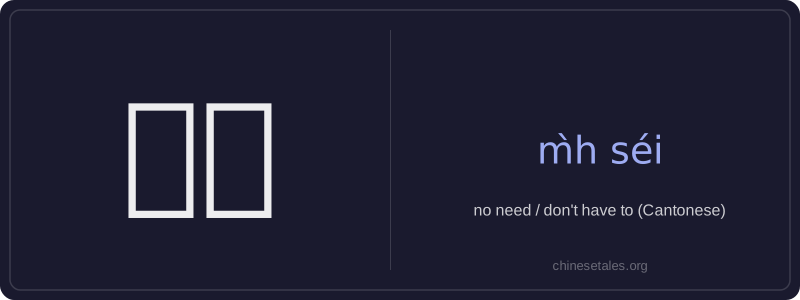
‘唔使’ is a common Cantonese phrase meaning ‘no need’ or ‘don’t have to’. It functions as a verb-like expression used to negate obligation or necessity, similar to Mandarin’s ‘不用’ (bù yòng). The first character 唔 is a Cantonese negation particle (equivalent to ‘not’), and the second character 使 means ‘to use’ or ‘to employ’, but here it carries the idiomatic sense of ‘to bother’ or ‘to go to the trouble of’. Together, they literally suggest ‘no need to use [effort/time]’, hence ‘it’s unnecessary’.
This phrase is widely used in informal spoken Cantonese across Hong Kong, Guangdong, and overseas communities. It often appears at the beginning or end of a sentence, frequently followed by a verb or verb phrase (e.g., 唔使諗 — ‘no need to worry’). Unlike Mandarin, it is rarely written in formal contexts but is ubiquitous in daily conversation, texts, and subtitles. Learners should recognize it as a fixed collocation—not analyzable word-by-word in standard Mandarin logic.
Example Sentences
Related Words
国语
‘Guó yǔ’ literally means 'national language'—
无论谁
‘无论谁’ (wú lùn shéi) is a pronoun meaning
不对
不对 (bù duì) literally combines 不 (bù), meani
外语
‘外语’ literally means ‘outside language’ —
我的
我的 (wǒ de) is a possessive pronoun meaning 'my'
亲笔
‘亲笔’ literally means ‘one’s own hand’—comb
违规
违规 (wéi guī) literally means 'to violate rules
面条
‘面条’ (miàn tiáo) literally means ‘flour str