Word Explanation
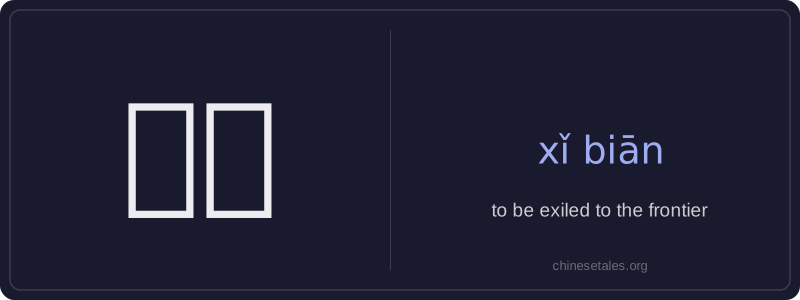
'徙边' literally means 'to move to the frontier' and historically refers to the official punishment of exiling convicts or disgraced officials to remote border regions—such as the northwestern deserts or southern mountainous areas—during imperial China. The character 徙 (xǐ) means 'to move, relocate, or banish', while 边 (biān) means 'border' or 'frontier'. Together, they form a formal, literary verb denoting state-imposed exile far from the political and cultural center.
This term appears primarily in historical texts, classical literature, and academic discussions of ancient Chinese penal systems. It is not used in modern daily speech; contemporary equivalents include '流放到边疆' (liú fàng dào biānjiāng) or '发配边疆' (fāpèi biānjiāng). While 徙边 carries strong connotations of hardship, isolation, and loss of status, it also subtly reflects imperial strategies for populating and securing distant territories through forced migration.
Example Sentences
Related Words
国语
‘Guó yǔ’ literally means 'national language'—
无论谁
‘无论谁’ (wú lùn shéi) is a pronoun meaning
不对
不对 (bù duì) literally combines 不 (bù), meani
外语
‘外语’ literally means ‘outside language’ —
我的
我的 (wǒ de) is a possessive pronoun meaning 'my'
亲笔
‘亲笔’ literally means ‘one’s own hand’—comb
违规
违规 (wéi guī) literally means 'to violate rules
面条
‘面条’ (miàn tiáo) literally means ‘flour str