Word Explanation
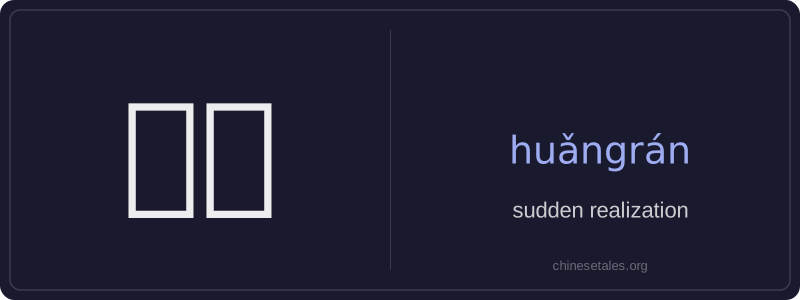
‘恍然’ is an adverb meaning ‘suddenly realizing something’—a flash of mental clarity, often after confusion, forgetfulness, or misunderstanding. The first character 恍 (huǎng) conveys a sense of vagueness or dazedness, while 然 (rán) functions as a suffix indicating a state or manner (like ‘-ly’ in English). Together, they form a compact expression for that instant when understanding clicks into place, like a light turning on.
This word appears frequently in spoken and written Chinese to describe moments of epiphany—whether recalling a forgotten name, grasping a difficult concept, or recognizing someone unexpectedly. It’s commonly paired with verbs like ‘大悟’ (dàwù, ‘thoroughly understand’) or used after ‘恍然’ alone before a clause (e.g., ‘恍然,原来是他!’). It carries a neutral-to-positive emotional tone and is appropriate in both casual and formal contexts, though it’s more literary than colloquial.
Example Sentences
Related Words
国语
‘Guó yǔ’ literally means 'national language'—
无论谁
‘无论谁’ (wú lùn shéi) is a pronoun meaning
不对
不对 (bù duì) literally combines 不 (bù), meani
外语
‘外语’ literally means ‘outside language’ —
我的
我的 (wǒ de) is a possessive pronoun meaning 'my'
亲笔
‘亲笔’ literally means ‘one’s own hand’—comb
违规
违规 (wéi guī) literally means 'to violate rules
面条
‘面条’ (miàn tiáo) literally means ‘flour str