Word Explanation
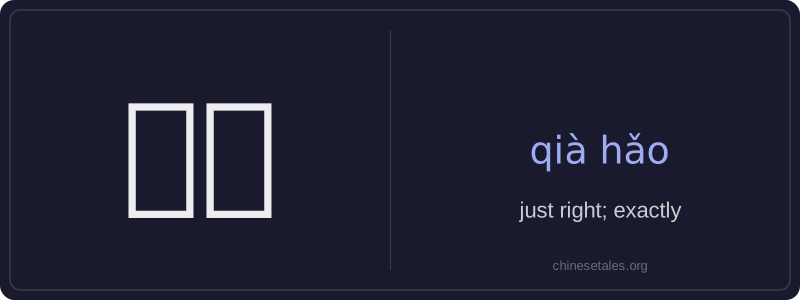
恰好 means 'just right' or 'exactly' — it emphasizes precise timing, quantity, or alignment with a situation. The character 恰 (qià) conveys 'just at that moment' or 'aptly', while 好 (hǎo) means 'good' or 'suitable'; together, they form an adverb expressing perfect coincidence or exact suitability. It’s commonly used to describe events that happen at the ideal moment — such as arriving just as someone leaves, or having precisely the amount needed.
This word is neutral in register and appears frequently in both spoken and written Chinese, especially when highlighting serendipity, convenience, or accuracy. It often modifies verbs (e.g., 恰好赶上, 恰好有), and can appear at the beginning or middle of a sentence. Unlike the more casual 就 (jiù) or the quantitative 刚好 (gāng hǎo), 恰好 carries a slightly more formal or literary tone and implies objective precision rather than subjective perception.
Example Sentences
Related Words
国语
‘Guó yǔ’ literally means 'national language'—
无论谁
‘无论谁’ (wú lùn shéi) is a pronoun meaning
不对
不对 (bù duì) literally combines 不 (bù), meani
外语
‘外语’ literally means ‘outside language’ —
我的
我的 (wǒ de) is a possessive pronoun meaning 'my'
亲笔
‘亲笔’ literally means ‘one’s own hand’—comb
违规
违规 (wéi guī) literally means 'to violate rules
面条
‘面条’ (miàn tiáo) literally means ‘flour str