Word Explanation
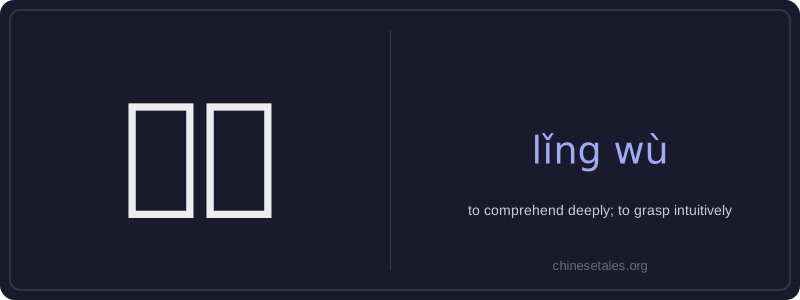
领悟 (lǐng wù) is a verb meaning 'to comprehend deeply' or 'to grasp intuitively' — not just surface-level understanding, but an insightful, often personal realization. The character 领 (lǐng) originally means 'to lead' or 'to take charge', suggesting active engagement and direction in learning; 悟 (wù) means 'to awaken' or 'to become aware', evoking sudden clarity or enlightenment. Together, they convey a mature, reflective kind of understanding that arises from experience, reflection, or exposure to complex ideas — such as philosophical concepts, emotional subtleties, or artistic expression.
This word is commonly used in academic, literary, or introspective contexts: students '领悟' a difficult theory, listeners '领悟' the deeper message in a poem, or someone '领悟' life’s impermanence after hardship. It implies effort and insight rather than passive reception, and carries a respectful, slightly formal tone — rarely used for simple factual knowledge (e.g., memorizing vocabulary), which would use 知道 or 理解 instead.
Example Sentences
Related Words
国语
‘Guó yǔ’ literally means 'national language'—
无论谁
‘无论谁’ (wú lùn shéi) is a pronoun meaning
不对
不对 (bù duì) literally combines 不 (bù), meani
外语
‘外语’ literally means ‘outside language’ —
我的
我的 (wǒ de) is a possessive pronoun meaning 'my'
亲笔
‘亲笔’ literally means ‘one’s own hand’—comb
违规
违规 (wéi guī) literally means 'to violate rules
面条
‘面条’ (miàn tiáo) literally means ‘flour str