Word Explanation
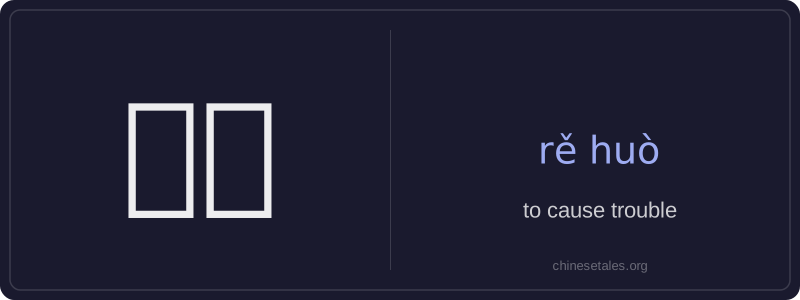
‘惹祸’ (rě huò) is a verb meaning ‘to cause trouble’ or ‘to get into trouble’ — typically by doing something careless, impulsive, or socially inappropriate. The first character 惹 (rě) means ‘to provoke’ or ‘to incur’, while 祸 (huò) means ‘disaster’, ‘misfortune’, or ‘trouble’. Together, they form an idiomatic compound that emphasizes the agent’s role in triggering negative consequences — not just experiencing trouble, but actively bringing it about.
This expression is commonly used in informal spoken and written Chinese to describe avoidable blunders: a child breaking a vase, someone speaking out of turn in a meeting, or a pet knocking over a lamp. It carries a mild-to-moderate tone of disapproval or gentle scolding — stronger than ‘make a mistake’ but less severe than ‘commit a crime’. It often appears in contexts involving responsibility, consequences, and social expectations.
Example Sentences
Related Words
国语
‘Guó yǔ’ literally means 'national language'—
无论谁
‘无论谁’ (wú lùn shéi) is a pronoun meaning
不对
不对 (bù duì) literally combines 不 (bù), meani
外语
‘外语’ literally means ‘outside language’ —
违规
违规 (wéi guī) literally means 'to violate rules
我的
我的 (wǒ de) is a possessive pronoun meaning 'my'
亲笔
‘亲笔’ literally means ‘one’s own hand’—comb
面条
‘面条’ (miàn tiáo) literally means ‘flour str