Word Explanation
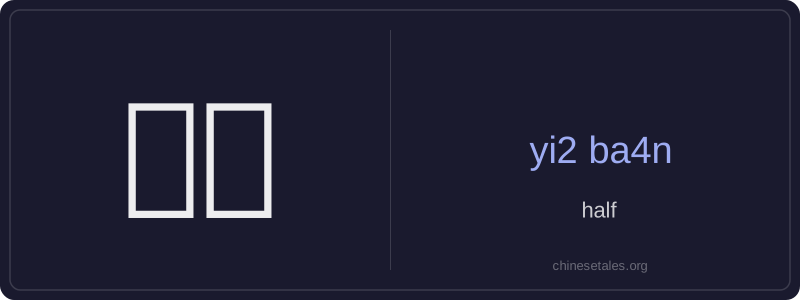
一半 (yí bàn) literally means 'one half' — combining 一 (yī), the numeral 'one', and 半 (bàn), meaning 'half'. It functions as a numeral expressing exactly 50% of a whole quantity, whether countable or uncountable. Unlike English, it’s not used alone as a pronoun (e.g., you wouldn’t say 'I’ll take 一半' without specifying what is being halved); it usually follows a measure word or noun (e.g., 一半苹果, 一半时间) or appears after a noun with 的 (e.g., 这本书的一半). It commonly appears in contexts involving division, sharing, estimation, or proportion.
The tone of 一 changes to yí before fourth-tone syllables like bàn — a standard tone sandhi rule. While 一半 can refer to physical halves (like cutting an apple), it’s equally frequent in abstract contexts: time, effort, responsibility, or probability. It does not imply approximation — for that, use 差不多 or 大概. In formal writing or speech, it may be replaced by 二分之一, but 一半 is far more common in daily spoken and written Chinese.
Example Sentences
Related Words
我的
我的 (wǒ de) is a possessive pronoun meaning 'my'
红色的
红色的 (hóng sè de) is an adjective meaning 'red
学校的
'学校的' is a possessive phrase meaning 'school's'
大的
大的 (dà de) is the attributive form of the adjec
你的
你的 (nǐ de) is a possessive pronoun meaning 'you
妈妈的
'妈妈的' (mā ma de) is a possessive noun phrase m
一天
‘一天’ literally combines the numeral ‘一’ (y
一样
‘一样’ (yí yàng) literally combines ‘一’ (y