Word Explanation
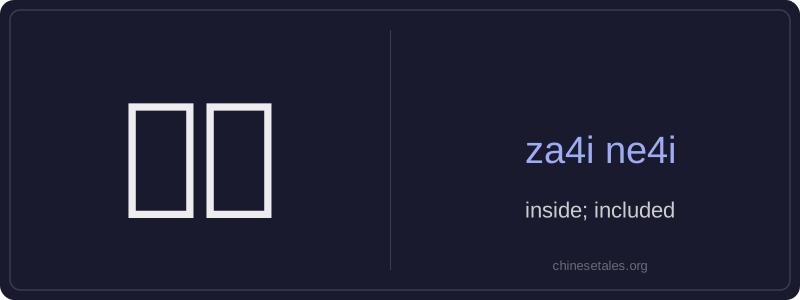
在内 is a prepositional phrase meaning 'inside' or 'included within'. It combines the verb 在 (zài), which indicates location or existence at a place, and the noun 内 (nèi), meaning 'inside', 'interior', or 'within'. Together, they form a fixed compound that emphasizes inclusion in a bounded space, group, or scope — not just physical containment but also conceptual or categorical inclusion. It often follows a noun or noun phrase to specify the boundary or domain.
This phrase is commonly used in formal or written Chinese, especially in descriptions of geographical areas, organizational structures, statistical summaries, or legal contexts. While it can appear after time expressions (e.g., 三年内), it’s distinct from the simpler 内 used alone: 在内 adds explicit emphasis on being situated *within* an already-mentioned or contextually clear boundary. It does not function as a standalone noun or verb — it always requires a preceding noun or pronoun to define what ‘inside’ refers to.
Example Sentences
Related Words
我的
我的 (wǒ de) is a possessive pronoun meaning 'my'
红色的
红色的 (hóng sè de) is an adjective meaning 'red
学校的
'学校的' is a possessive phrase meaning 'school's'
大的
大的 (dà de) is the attributive form of the adjec
你的
你的 (nǐ de) is a possessive pronoun meaning 'you
妈妈的
'妈妈的' (mā ma de) is a possessive noun phrase m
一天
‘一天’ literally combines the numeral ‘一’ (y
一样
‘一样’ (yí yàng) literally combines ‘一’ (y