Word Explanation
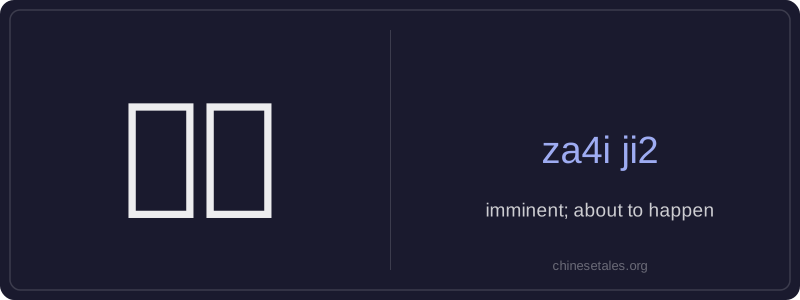
'在即' is a formal, literary adjective meaning 'imminent' or 'about to happen very soon.' The character 在 (zài) means 'at' or 'present,' and 即 (jí) means 'immediately' or 'right at that moment'; together, they convey the sense of something being 'already at the point of occurrence.' It emphasizes urgency and nearness in time, often used in written notices, announcements, speeches, or formal correspondence.
This phrase typically follows a noun indicating an event or deadline — for example, '毕业典礼在即' (graduation ceremony is imminent) — and rarely appears at the beginning or end of a sentence. It carries a slightly elevated, solemn tone and is uncommon in casual spoken Chinese. Learners should avoid using it in everyday conversation; instead, opt for more colloquial alternatives like '马上就要…了' or '快…了' in informal settings.
Example Sentences
Related Words
我的
我的 (wǒ de) is a possessive pronoun meaning 'my'
红色的
红色的 (hóng sè de) is an adjective meaning 'red
学校的
'学校的' is a possessive phrase meaning 'school's'
大的
大的 (dà de) is the attributive form of the adjec
在家
'Zài jiā' literally combines the preposition 'z
你的
你的 (nǐ de) is a possessive pronoun meaning 'you
妈妈的
'妈妈的' (mā ma de) is a possessive noun phrase m
一天
‘一天’ literally combines the numeral ‘一’ (y