Word Explanation
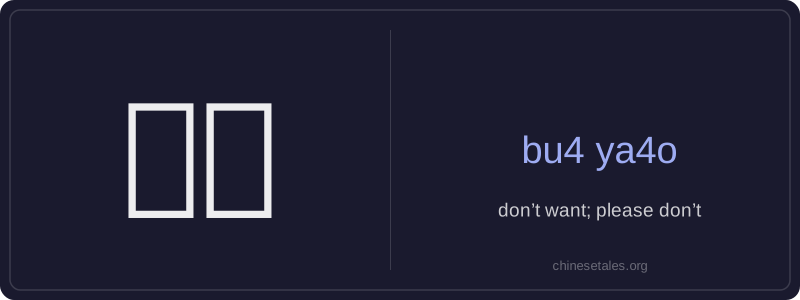
'不要' (bù yào) is a two-character verb phrase meaning 'don’t want' or 'please don’t'. The first character 不 (bù) is the standard negation particle, and 要 (yào) means 'to want', 'to need', or 'to be going to' — here it carries the sense of desire or intention. Together, they form a direct, common way to express refusal, rejection, or polite prohibition. It’s frequently used in everyday speech to decline offers, reject suggestions, or stop someone from doing something.
The phrase functions as both a standalone interjection ('No!') and a verb complement (e.g., after subject + 不要 + verb). Tone sandhi applies: 不 changes to bú before fourth-tone syllables like yào, but in standard pinyin transcription, it remains written as bù yào. It’s neutral in register — appropriate for informal conversations with friends and moderately formal contexts with strangers, though softer alternatives like '麻烦您别…' may be preferred in highly formal situations.
Example Sentences
Related Words
我的
我的 (wǒ de) is a possessive pronoun meaning 'my'
红色的
红色的 (hóng sè de) is an adjective meaning 'red
学校的
'学校的' is a possessive phrase meaning 'school's'
大的
大的 (dà de) is the attributive form of the adjec
在家
'Zài jiā' literally combines the preposition 'z
你的
你的 (nǐ de) is a possessive pronoun meaning 'you
妈妈的
'妈妈的' (mā ma de) is a possessive noun phrase m
一天
‘一天’ literally combines the numeral ‘一’ (y