Word Explanation
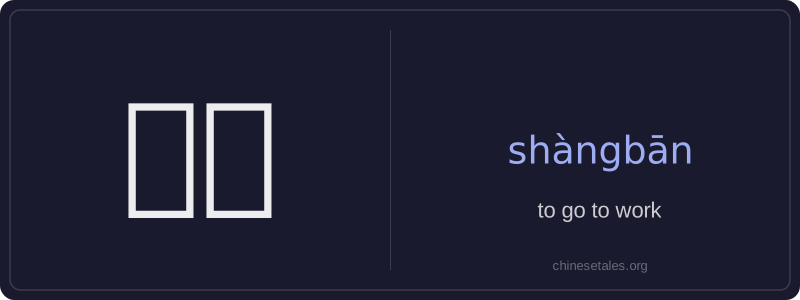
'Shàngbān' literally combines 'shàng' (to go up, to attend) and 'bān' (work shift, job, or class), forming a verb meaning 'to go to work'—specifically the daily act of arriving at one's workplace to begin working hours. It emphasizes the routine, scheduled nature of employment and is used almost exclusively for formal or regular jobs, not freelance or occasional tasks.
The term is neutral in register and widely used across spoken and written Chinese. It commonly appears in time-related contexts ('shàngbān hěn zǎo' — goes to work very early) or with duration markers ('yǐjīng shàngbān le' — has already gone to work). Unlike English 'go to work', 'shàngbān' does not require an object and rarely takes location complements unless explicitly specifying where (e.g., 'qù gōngsī shàngbān'). It’s often paired with 'xiàbān' (to finish work) to frame the full workday.
Example Sentences
Related Words
我的
我的 (wǒ de) is a possessive pronoun meaning 'my'
中国
‘Zhōngguó’ literally means ‘Middle Kingdom’
在家
'Zài jiā' literally combines the preposition 'z
中学
'Zhōngxué' literally combines 'zhōng' (middle)
红色的
红色的 (hóng sè de) is an adjective meaning 'red
一天
‘一天’ literally combines the numeral ‘一’ (y
不对
不对 (bù duì) literally combines 不 (bù), meani
不要
'不要' (bù yào) is a two-character verb phrase m