Word Explanation
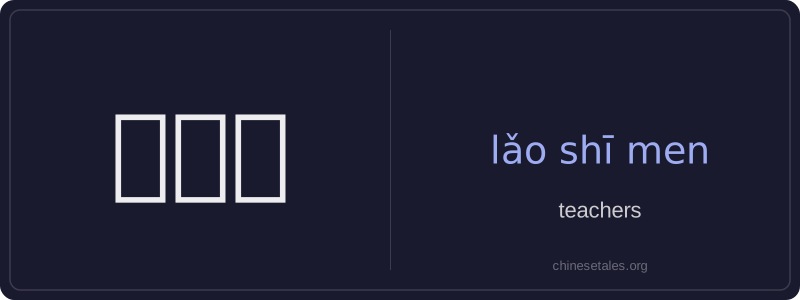
'老师们' is the plural form of '老师' (lǎo shī), meaning 'teacher'. The character '老' literally means 'old' but here functions as an honorific prefix; '师' means 'master' or 'teacher'; together, '老师' is a respectful term for any educator or knowledgeable person. The suffix '们' (men) is a plural marker used exclusively with human nouns, indicating two or more teachers — it cannot be used with objects, animals, or abstract concepts.
This word appears frequently in school settings, formal letters, public announcements, and everyday speech when addressing or referring to multiple educators collectively. Unlike English, Chinese doesn’t require articles ('the' or 'a'), and '老师们' carries inherent respect and inclusivity — it’s commonly used in greetings (e.g., '老师们好!') or acknowledgments (e.g., '感谢老师们'). It’s never used for non-human subjects or in possessive constructions without additional particles like '的'.
Example Sentences
Related Words
我的
我的 (wǒ de) is a possessive pronoun meaning 'my'
中国
‘Zhōngguó’ literally means ‘Middle Kingdom’
一天
‘一天’ literally combines the numeral ‘一’ (y
在家
'Zài jiā' literally combines the preposition 'z
不要
'不要' (bù yào) is a two-character verb phrase m
这边
这边 (zhè biān) literally combines 这 (zhè, 'th
这么
这么 (zhè me) is an adverb meaning 'so' or 'this
中学
'Zhōngxué' literally combines 'zhōng' (middle)