Word Explanation
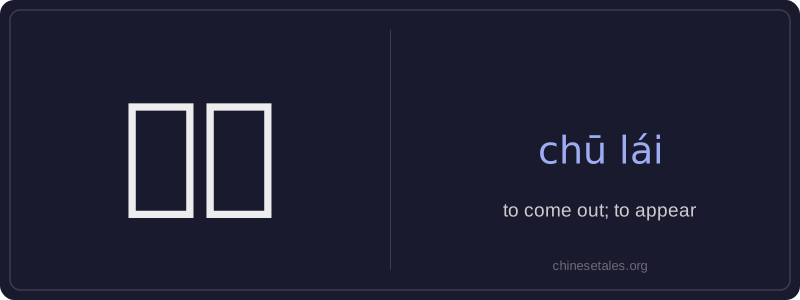
‘出来’ (chū lái) is a separable verb meaning ‘to come out’ or ‘to appear’, indicating movement from inside to outside, emergence from concealment, or the sudden appearance of something previously unseen or unknown. The first character 出 (chū) means ‘to go out’ or ‘to exit’, while 来 (lái) adds directionality toward the speaker or observer — together, they emphasize motion toward the speaker’s location or into view. It often follows verbs (e.g., 走出来, 拿出来) or appears after nouns in resultative constructions (e.g., 答案出来了).
This word is highly versatile: it can describe physical emergence (a rabbit hopping out of a burrow), abstract emergence (a problem coming to light), or even realization (an idea occurring to someone). It frequently appears in everyday speech and writing, especially in narratives, instructions, and descriptions of change or discovery. Unlike standalone verbs, ‘出来’ rarely stands alone; it usually attaches to or follows another verb or noun to complete meaning.
Example Sentences
Related Words
我的
我的 (wǒ de) is a possessive pronoun meaning 'my'
中国
‘Zhōngguó’ literally means ‘Middle Kingdom’
一天
‘一天’ literally combines the numeral ‘一’ (y
在家
'Zài jiā' literally combines the preposition 'z
不要
'不要' (bù yào) is a two-character verb phrase m
这边
这边 (zhè biān) literally combines 这 (zhè, 'th
这么
这么 (zhè me) is an adverb meaning 'so' or 'this
中学
'Zhōngxué' literally combines 'zhōng' (middle)