Word Explanation
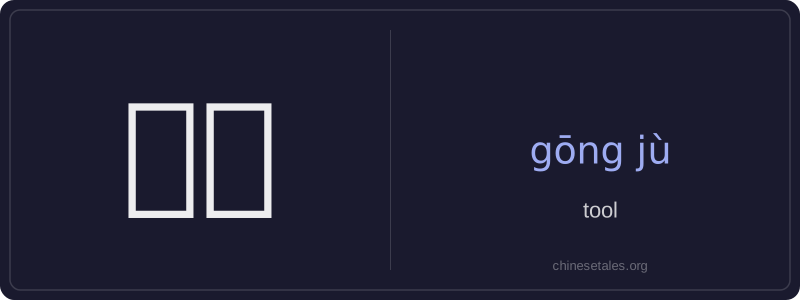
工具 (gōng jù) literally means 'work device' — 工 (gōng) means 'work' or 'labor', and 具 (jù) means 'device', 'implement', or 'instrument'. Together, they form a general term for any physical object used to carry out a task, whether simple (like a hammer or knife) or complex (like software or machinery). It emphasizes function over form and is widely used in both everyday and technical contexts.
This word applies to tangible tools (e.g., screwdrivers, brushes) as well as abstract or digital tools (e.g., a language-learning app might be called 语言学习工具). Unlike more specific terms like 器械 (qì xiè, 'equipment') or 器具 (qì jù, 'utensil'), 工具 is neutral, broad, and commonly taught early in Chinese learning. It’s frequently paired with classifiers like 个 or 种, and often appears in compound nouns such as 学习工具 ('learning tool') or 办公工具 ('office tool').
Example Sentences
Related Words
我的
我的 (wǒ de) is a possessive pronoun meaning 'my'
中国
‘Zhōngguó’ literally means ‘Middle Kingdom’
不对
不对 (bù duì) literally combines 不 (bù), meani
学校的
'学校的' is a possessive phrase meaning 'school's'
一天
‘一天’ literally combines the numeral ‘一’ (y
在家
'Zài jiā' literally combines the preposition 'z
不要
'不要' (bù yào) is a two-character verb phrase m
这边
这边 (zhè biān) literally combines 这 (zhè, 'th