Word Explanation
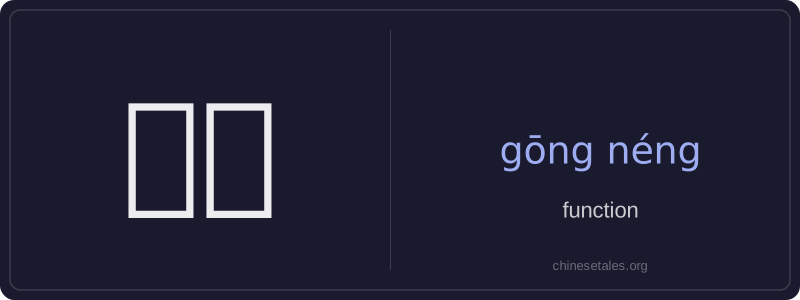
'功能' (gōng néng) literally combines '功' (gōng), meaning 'work', 'effort', or 'achievement', and '能' (néng), meaning 'ability' or 'capacity'. Together, they form a noun meaning 'function' — the specific purpose, role, or activity that something is designed or naturally able to perform. It’s widely used in technical, medical, and everyday contexts, such as describing what a device does ('this app has many functions') or how a body system operates ('liver function'). Unlike the English word 'function', 功能 is almost never used as a verb in Chinese.
The term emphasizes practical utility rather than abstract mathematical or formal definitions. It appears frequently in product manuals, healthcare reports, software interfaces, and scientific discussions. While it can refer to biological roles (e.g., kidney function), it's not limited to living things — machines, apps, and even social institutions have 功能. It's a neutral, standard-register term suitable for both spoken and written Chinese.
Example Sentences
Related Words
我的
我的 (wǒ de) is a possessive pronoun meaning 'my'
中国
‘Zhōngguó’ literally means ‘Middle Kingdom’
不对
不对 (bù duì) literally combines 不 (bù), meani
红色的
红色的 (hóng sè de) is an adjective meaning 'red
学校的
'学校的' is a possessive phrase meaning 'school's'
一天
‘一天’ literally combines the numeral ‘一’ (y
在家
'Zài jiā' literally combines the preposition 'z
不要
'不要' (bù yào) is a two-character verb phrase m