Word Explanation
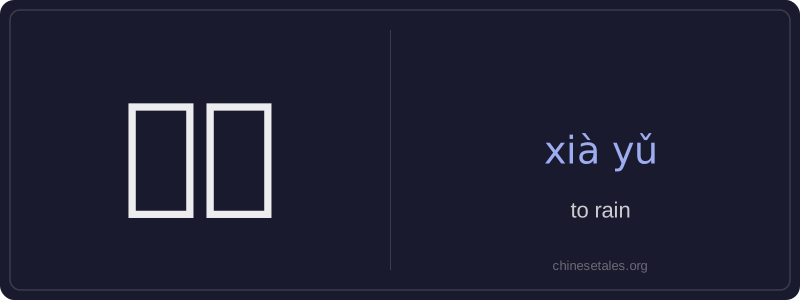
'Xià yǔ' literally means 'to descend rain' — the character 下 (xià) means 'to go down' or 'to fall', and 雨 (yǔ) means 'rain'. Together, they form an intransitive verb meaning 'to rain', describing the natural phenomenon of precipitation falling from the sky. Unlike English, where 'rain' can be both noun and verb without change, in Chinese this two-character compound is used exclusively as a verb and requires no object.
This word appears frequently in weather reports, daily conversation, and forecasts. It’s neutral in register — appropriate for casual speech, writing, and formal contexts alike. Note that it does not take aspect markers like 了 or 过 directly without a subject or time context (e.g., we say 昨天下雨了, not *下雨了 alone as a standalone sentence). It’s often paired with time words (今天、明天), location (北京、山上), or modality (可能、要、快).
Example Sentences
Related Words
我的
我的 (wǒ de) is a possessive pronoun meaning 'my'
中国
‘Zhōngguó’ literally means ‘Middle Kingdom’
不对
不对 (bù duì) literally combines 不 (bù), meani
红色的
红色的 (hóng sè de) is an adjective meaning 'red
学校的
'学校的' is a possessive phrase meaning 'school's'
一天
‘一天’ literally combines the numeral ‘一’ (y
在家
'Zài jiā' literally combines the preposition 'z
不要
'不要' (bù yào) is a two-character verb phrase m