Word Explanation
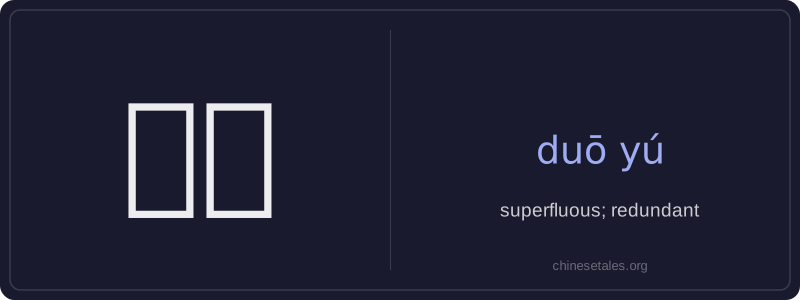
多余 (duō yú) is an adjective meaning 'superfluous' or 'redundant'—describing something that exists beyond what is necessary, useful, or wanted. The character 多 means 'many' or 'excess', and 余 means 'remaining' or 'leftover'; together, they convey the idea of 'what remains after necessity is met'—hence, unnecessary surplus. It’s commonly used to describe objects, information, people in a given context, or even abstract elements like words in a sentence or steps in a process.
This word carries a neutral-to-slightly-negative connotation; it implies inefficiency or lack of purpose rather than mere abundance. It often appears in critiques of bureaucracy, over-engineering, or verbose communication. While it can modify nouns directly (e.g., 多余的步骤), it frequently follows 是 (shì) in predicate constructions (e.g., 这是多余的). It does not function as a noun on its own—unlike English 'the redundant', Chinese requires a noun or measure word for nominal use (e.g., 多余的东西).
Example Sentences
Related Words
我的
我的 (wǒ de) is a possessive pronoun meaning 'my'
在家
'Zài jiā' literally combines the preposition 'z
中国
‘Zhōngguó’ literally means ‘Middle Kingdom’
红色的
红色的 (hóng sè de) is an adjective meaning 'red
一天
‘一天’ literally combines the numeral ‘一’ (y
不对
不对 (bù duì) literally combines 不 (bù), meani
这边
这边 (zhè biān) literally combines 这 (zhè, 'th
这么
这么 (zhè me) is an adverb meaning 'so' or 'this