Word Explanation
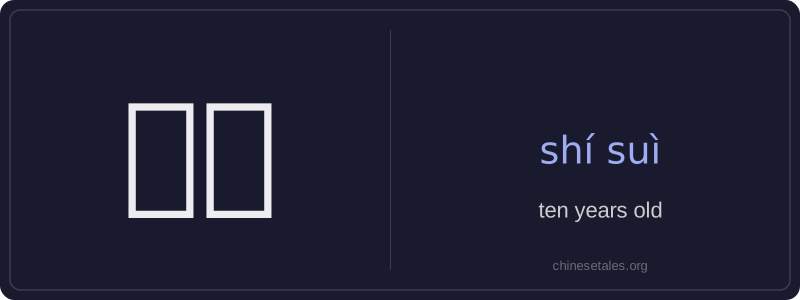
‘十岁’ literally means ‘ten years’ and is used exclusively to express a person’s age — specifically, being ten years old. The first character 十 (shí) is the numeral ‘ten’, while 岁 (suì) means ‘year’ in the context of human age, similar to ‘years old’ in English. Unlike general time expressions (e.g., 十年 for ‘ten years’), 岁 always refers to age when paired with numerals and is never used for durations like ‘ten years of study’ or ‘ten years ago’.
This term is commonly used in everyday speech and writing when describing children’s ages — especially in school contexts, medical records, family conversations, or birthday celebrations. It functions as a noun phrase and typically appears after a subject (e.g., 他十岁了 — ‘He is ten years old’) or as a predicate complement. It cannot stand alone as a subject without context (e.g., *十岁很聪明 is incomplete; you need a subject like 他十岁很聪明 or 十岁的孩子很聪明).
Example Sentences
Related Words
我的
我的 (wǒ de) is a possessive pronoun meaning 'my'
在家
'Zài jiā' literally combines the preposition 'z
不对
不对 (bù duì) literally combines 不 (bù), meani
中国
‘Zhōngguó’ literally means ‘Middle Kingdom’
红色的
红色的 (hóng sè de) is an adjective meaning 'red
一天
‘一天’ literally combines the numeral ‘一’ (y
一心
‘一心’ literally combines ‘one’ (一) and ‘hea
这边
这边 (zhè biān) literally combines 这 (zhè, 'th