Word Explanation
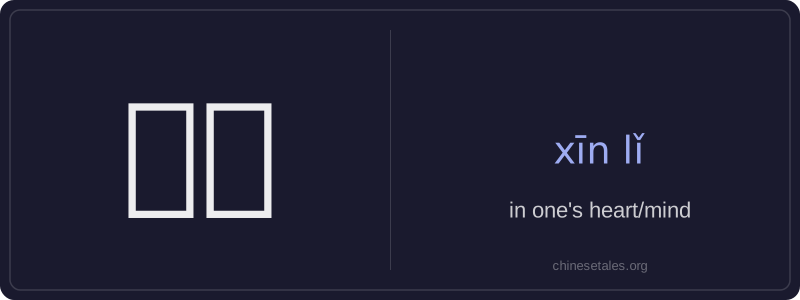
心里 (xīn lǐ) literally means 'inside the heart' and functions as a noun meaning 'in one’s heart/mind' — referring to inner thoughts, feelings, emotions, or unspoken intentions. Though 心 (xīn) means 'heart' and 里 (lǐ) means 'inside' or 'within,' together they form an abstract spatial metaphor for the internal mental-emotional realm, not a physical location. It emphasizes subjectivity, privacy, and sincerity — what someone truly feels or thinks, often contrasting with outward behavior.
This term is commonly used in expressions about hidden emotions ('心里很高兴' — 'happy inside'), suppressed reactions ('心里很生气但没表现出来' — 'angry inside but didn’t show it'), or personal convictions ('我心里很清楚' — 'I know clearly in my heart/mind'). It frequently appears after pronouns (e.g., 我心里, 他心里) or demonstratives (e.g., 这件事我心里有数), and rarely stands alone without a modifier.
Example Sentences
Related Words
我的
我的 (wǒ de) is a possessive pronoun meaning 'my'
在家
'Zài jiā' literally combines the preposition 'z
不对
不对 (bù duì) literally combines 不 (bù), meani
这边
这边 (zhè biān) literally combines 这 (zhè, 'th
中国
‘Zhōngguó’ literally means ‘Middle Kingdom’
中学
'Zhōngxué' literally combines 'zhōng' (middle)
红色的
红色的 (hóng sè de) is an adjective meaning 'red
一天
‘一天’ literally combines the numeral ‘一’ (y