Word Explanation
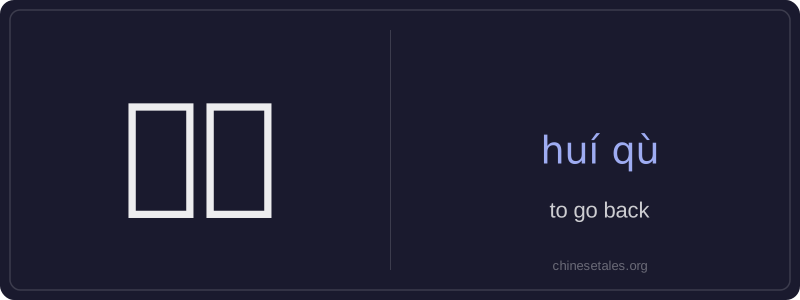
‘回去’ (huí qù) is a compound verb meaning 'to go back' or 'to return' to a previously mentioned or understood place—most commonly home, but also to a prior location like an office, school, or city. The character 回 (huí) means 'to return' or 'to circle back', while 去 (qù) means 'to go'. Together, they form a directional verb phrase indicating movement toward a prior location, not just any destination. It is frequently used in daily conversation to describe leaving the current place and returning to a familiar one.
This verb is often used with time words (e.g., 现在、明天), subject pronouns (e.g., 我、他), or as a response to invitations or plans. Unlike standalone verbs such as 走 (zǒu, 'to leave') or 离开 (líkāi, 'to depart'), 回去 specifically emphasizes the idea of returning—not just departure, but return to a point of origin. It’s neutral in register and appropriate in both casual and formal speech, though it rarely appears in highly literary or abstract contexts.
Example Sentences
Related Words
我的
我的 (wǒ de) is a possessive pronoun meaning 'my'
这边
这边 (zhè biān) literally combines 这 (zhè, 'th
中国
‘Zhōngguó’ literally means ‘Middle Kingdom’
一天
‘一天’ literally combines the numeral ‘一’ (y
一心
‘一心’ literally combines ‘one’ (一) and ‘hea
在家
'Zài jiā' literally combines the preposition 'z
不对
不对 (bù duì) literally combines 不 (bù), meani
中学
'Zhōngxué' literally combines 'zhōng' (middle)