Word Explanation
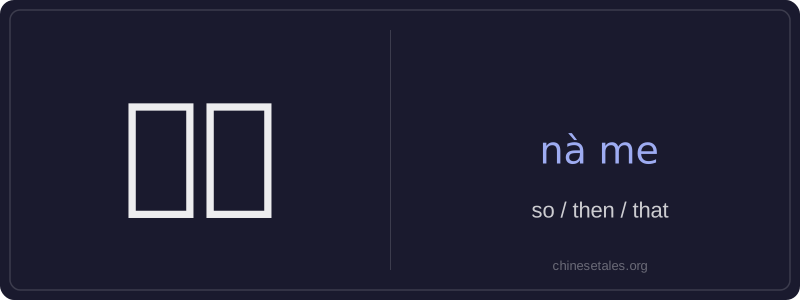
那么 (nà me) is an adverb or conjunction meaning 'so', 'then', or 'that'—used to indicate consequence, degree, or contrast. It combines 那 (nà), meaning 'that', and 么 (me), a grammatical particle that softens or emphasizes the preceding word. Though written as two characters, it functions as a single unit and is never separated in speech or writing.
It commonly appears in cause-effect structures (e.g., 因为…那么…), comparisons (e.g., 那么高), or rhetorical questions (e.g., 那么怎么办?). Unlike English 'so', 那么 rarely begins a sentence on its own—it usually follows a clause or adjective to intensify meaning or introduce a logical next step. It’s neutral in register and widely used in both spoken and written Mandarin, especially in explanations, instructions, and everyday reasoning.
Example Sentences
Related Words
我的
我的 (wǒ de) is a possessive pronoun meaning 'my'
这边
这边 (zhè biān) literally combines 这 (zhè, 'th
中国
‘Zhōngguó’ literally means ‘Middle Kingdom’
一天
‘一天’ literally combines the numeral ‘一’ (y
一心
‘一心’ literally combines ‘one’ (一) and ‘hea
在家
'Zài jiā' literally combines the preposition 'z
不对
不对 (bù duì) literally combines 不 (bù), meani
这么
这么 (zhè me) is an adverb meaning 'so' or 'this