Word Explanation
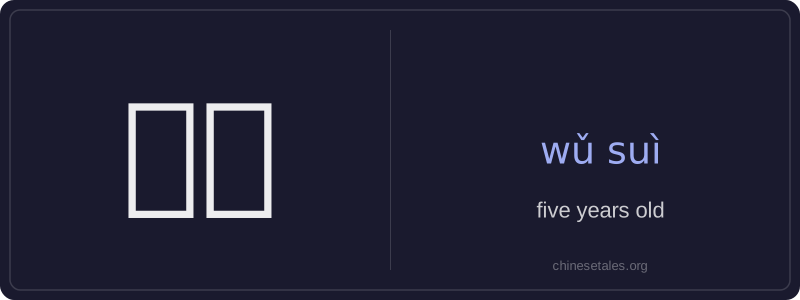
'Wǔ suì' literally combines the numeral 五 (wǔ, 'five') and the measure word 岁 (suì, 'year [of age]'), forming a compound that expresses a person’s age in years. Unlike English, Chinese uses 岁 exclusively for human age (not for objects or animals), and it always follows the number directly with no particle like 'years old'. It is commonly used in statements, questions, and comparisons about age, especially when referring to children.
This term appears frequently in everyday conversation, parenting contexts, school enrollment requirements, and medical records. Note that 岁 is not used for non-human subjects — for animals, you’d use 年 (nián) instead (e.g., 这只狗三岁了 is incorrect; say 这只狗三年了). Also, while 五岁 is neutral and standard, it’s rarely used alone without context — it typically appears in full phrases like '他五岁了' ('He is five years old') or '五岁的孩子' ('a five-year-old child').
Example Sentences
Related Words
我的
我的 (wǒ de) is a possessive pronoun meaning 'my'
这么
这么 (zhè me) is an adverb meaning 'so' or 'this
这边
这边 (zhè biān) literally combines 这 (zhè, 'th
中国
‘Zhōngguó’ literally means ‘Middle Kingdom’
一天
‘一天’ literally combines the numeral ‘一’ (y
一心
‘一心’ literally combines ‘one’ (一) and ‘hea
在家
'Zài jiā' literally combines the preposition 'z
不对
不对 (bù duì) literally combines 不 (bù), meani