Word Explanation
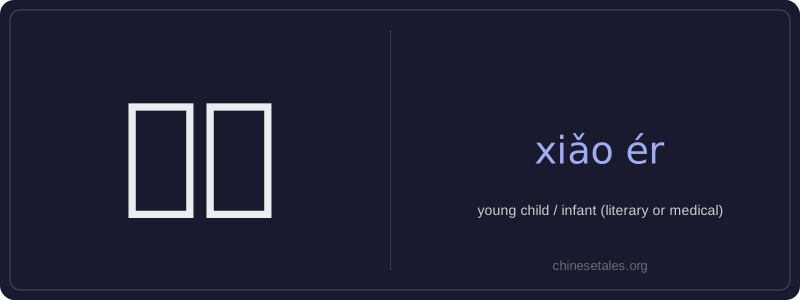
'Xiǎo ér' literally combines 'xiǎo' (small) and 'ér' (child), forming a formal or literary term for 'young child' or 'infant'. Unlike the colloquial 'háizi' or 'xiǎo háizi', 'xiǎo ér' carries a restrained, often respectful or technical tone — it's frequently used in classical texts, medical contexts (e.g., pediatrics), and official documents. It rarely appears in casual daily speech among friends or family.
The term emphasizes youth and vulnerability, sometimes evoking tenderness or clinical precision depending on context. In Traditional Chinese Medicine (TCM), 'xiǎo ér tuī ná' (pediatric massage) is a well-known therapy, and phrases like 'xiǎo ér kē' refer specifically to the pediatric department in hospitals. While grammatically a noun, it can function attributively (e.g., 'xiǎo ér yào' — children’s medicine), but never as a verb or adjective.
Example Sentences
Related Words
我的
我的 (wǒ de) is a possessive pronoun meaning 'my'
这么
这么 (zhè me) is an adverb meaning 'so' or 'this
这边
这边 (zhè biān) literally combines 这 (zhè, 'th
中国
‘Zhōngguó’ literally means ‘Middle Kingdom’
中学
'Zhōngxué' literally combines 'zhōng' (middle)
一天
‘一天’ literally combines the numeral ‘一’ (y
一心
‘一心’ literally combines ‘one’ (一) and ‘hea
在家
'Zài jiā' literally combines the preposition 'z