Word Explanation
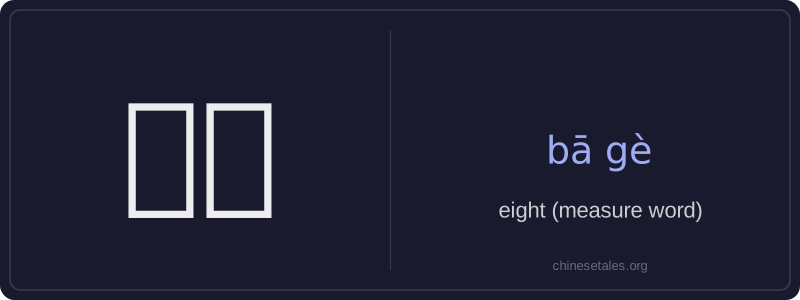
八个 (bā gè) means 'eight' followed by the general measure word 个 (gè), used to count discrete, non-specific nouns—especially in informal speech. The character 八 (bā) is the numeral 'eight', while 个 (gè) is the most common and versatile measure word in Mandarin, often used for people, objects, and abstract items when no more specific classifier applies (e.g., not animals or long objects). It’s grammatically required between numerals and nouns in Chinese: you cannot say *八苹果; you must say 八个苹果.
This phrase appears frequently in daily counting contexts—ordering food, listing items, describing small groups—or in beginner-level language practice. Though 个 is neutral in register, 八个 itself carries no special connotation beyond quantity; it’s neither formal nor colloquial but simply standard for basic counting. Note that while 个 works for many nouns, native speakers prefer more precise classifiers (e.g., 只 for animals, 张 for flat objects) in careful or formal speech.
Example Sentences
Related Words
我的
我的 (wǒ de) is a possessive pronoun meaning 'my'
这么
这么 (zhè me) is an adverb meaning 'so' or 'this
这边
这边 (zhè biān) literally combines 这 (zhè, 'th
中国
‘Zhōngguó’ literally means ‘Middle Kingdom’
中学
'Zhōngxué' literally combines 'zhōng' (middle)
一天
‘一天’ literally combines the numeral ‘一’ (y
一心
‘一心’ literally combines ‘one’ (一) and ‘hea
在家
'Zài jiā' literally combines the preposition 'z