Word Explanation
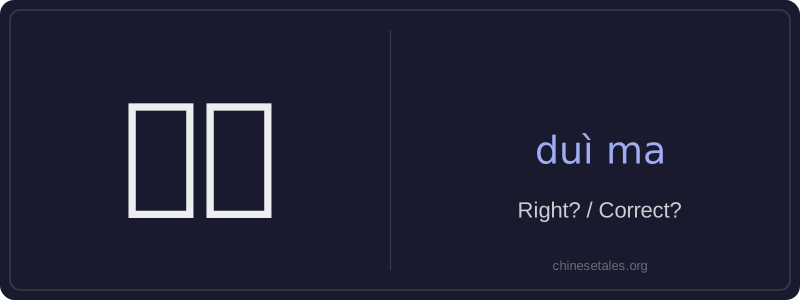
'对吗' (duì ma) is a common interrogative particle phrase used to seek confirmation or verification, equivalent to 'Right?' or 'Correct?' in English. It consists of the adjective '对' (duì), meaning 'correct' or 'right', and the question particle '吗' (ma), which turns a statement into a yes/no question. Together, they form a soft, polite way to check understanding, confirm facts, or invite agreement—often used in conversations where the speaker assumes something is true but wants reassurance.
This phrase frequently appears in daily interactions: when clarifying instructions ('You’ll call me tomorrow, right?'), confirming shared knowledge ('The meeting starts at 3, right?'), or checking comprehension after an explanation. It carries a cooperative, non-confrontational tone and is appropriate in both casual and semi-formal settings. Unlike '是吗' (shì ma), which focuses on truth value of a statement, '对吗' emphasizes correctness or alignment with facts or expectations.
Example Sentences
Related Words
我的
我的 (wǒ de) is a possessive pronoun meaning 'my'
这么
这么 (zhè me) is an adverb meaning 'so' or 'this
这边
这边 (zhè biān) literally combines 这 (zhè, 'th
中国
‘Zhōngguó’ literally means ‘Middle Kingdom’
中学
'Zhōngxué' literally combines 'zhōng' (middle)
见面
见面 literally means 'see face' — combining 见 (t
后来
Later (hòulái) is an adverb meaning 'afterwards'
背后
背后 literally means 'back + behind' and functions