Word Explanation
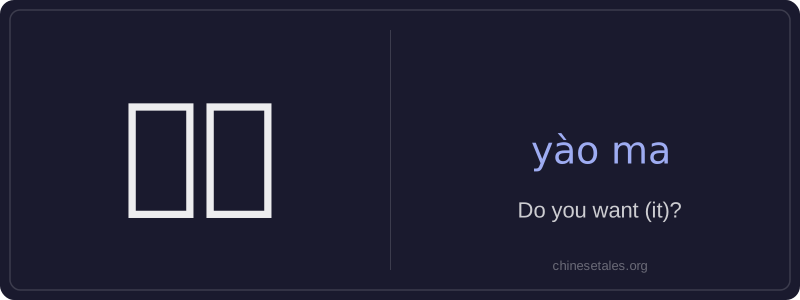
'要吗' (yào ma) is a common, informal question phrase used to ask whether someone wants or would like something. It combines the verb 要 (yào), meaning 'to want' or 'to need', with the question particle 吗 (ma), which turns any statement into a yes/no question. Unlike formal alternatives, '要吗' carries a light, conversational tone — it’s frequently used in daily interactions such as offering food, drinks, help, or items.
This phrase is typically placed at the end of a sentence and often follows a noun or noun phrase that names the thing being offered. It assumes shared context — for example, if you hold out a cookie and say '这个饼干要吗?', the listener understands you’re asking about *that cookie*. It’s rarely used in isolation without a subject or object, and never with negation before the verb (e.g., *不要吗* means 'Don’t you want it?', a different nuance). Native speakers use it constantly in casual speech, but avoid it in formal writing or very polite service contexts where '您想要……吗?' is preferred.
Example Sentences
Related Words
我的
我的 (wǒ de) is a possessive pronoun meaning 'my'
这么
这么 (zhè me) is an adverb meaning 'so' or 'this
这边
这边 (zhè biān) literally combines 这 (zhè, 'th
中国
‘Zhōngguó’ literally means ‘Middle Kingdom’
中学
'Zhōngxué' literally combines 'zhōng' (middle)
见面
见面 literally means 'see face' — combining 见 (t
后来
Later (hòulái) is an adverb meaning 'afterwards'
背后
背后 literally means 'back + behind' and functions