Word Explanation
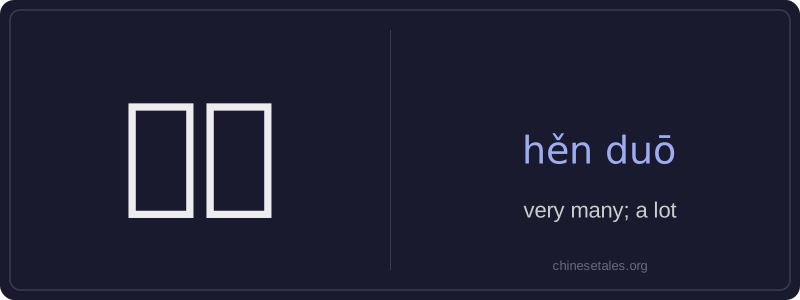
很 (hěn) means 'very' and 多 (duō) means 'many' or 'much'. Together, 很多 literally means 'very many' and functions as a quantifier meaning 'a lot of' or 'many'. Unlike English, it cannot stand alone as a noun; it must modify a noun (e.g., 很多书, 'many books') or follow verbs like 有 or 是 (e.g., 有很多人, 'there are many people'). It’s neutral in register—common in both speech and writing—and used across contexts including counting people, objects, animals, or abstract concepts.
Although it looks like an adjective, 很多 behaves more like a pre-nominal quantifier: it always comes before the noun it modifies and doesn’t take aspect particles (e.g., 了, 过) or degree adverbs (e.g., 更, 最). It’s not used after nouns (unlike English 'a lot' in 'I have a lot'), nor does it function as a pronoun by itself. Native speakers often use it to express abundance without specifying exact quantity, making it especially useful when precision isn’t needed or possible.
Example Sentences
Related Words
见面
见面 literally means 'see face' — combining 见 (t
后来
Later (hòulái) is an adverb meaning 'afterwards'
背后
背后 literally means 'back + behind' and functions
我的
我的 (wǒ de) is a possessive pronoun meaning 'my'
这么
这么 (zhè me) is an adverb meaning 'so' or 'this
中学
'Zhōngxué' literally combines 'zhōng' (middle)
前面
前面 (qián miàn) literally combines 前 (qián, '
面条
‘面条’ (miàn tiáo) literally means ‘flour str