Word Explanation
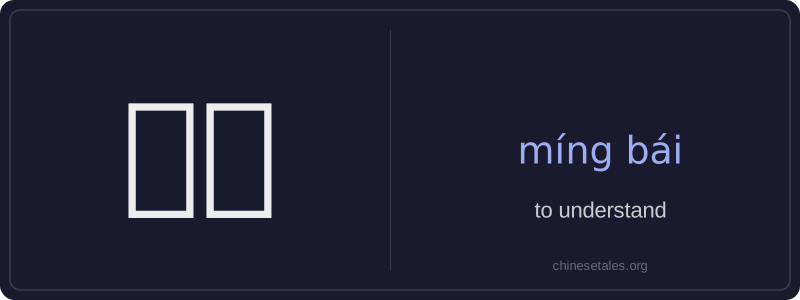
‘明白’ (míng bái) is a verb meaning ‘to understand’ or ‘to comprehend’—it expresses the mental state of grasping information, an idea, or someone’s intention. The character 明 (míng) means ‘bright’ or ‘clear’, and 白 (bái) means ‘white’ or ‘plain’, together evoking the image of something transparent, unobstructed, and easy to see—hence, clear understanding. It’s commonly used in both spoken and written Chinese, often as a predicate verb after the subject, and can also function as an adjective meaning ‘clear’ or ‘obvious’ in certain contexts (e.g., 明白的道理).
Unlike more formal synonyms like 理解 (lǐjiě), ‘明白’ feels natural and conversational—it appears frequently in daily interactions, instructions, confirmations, and self-reflection. It can be used with aspect particles (e.g., 明白了 for ‘now I understand’) and is often paired with question words like ‘吗’ or ‘没有’ to form yes/no questions (e.g., 你明白了吗?). It does not take an object marker ‘了’ when used intransitively, but may take a clause or noun phrase as its object (e.g., 明白这个道理).
Example Sentences
Related Words
见面
见面 literally means 'see face' — combining 见 (t
后来
Later (hòulái) is an adverb meaning 'afterwards'
背后
背后 literally means 'back + behind' and functions
我的
我的 (wǒ de) is a possessive pronoun meaning 'my'
这么
这么 (zhè me) is an adverb meaning 'so' or 'this
中学
'Zhōngxué' literally combines 'zhōng' (middle)
前面
前面 (qián miàn) literally combines 前 (qián, '
面条
‘面条’ (miàn tiáo) literally means ‘flour str