Word Explanation
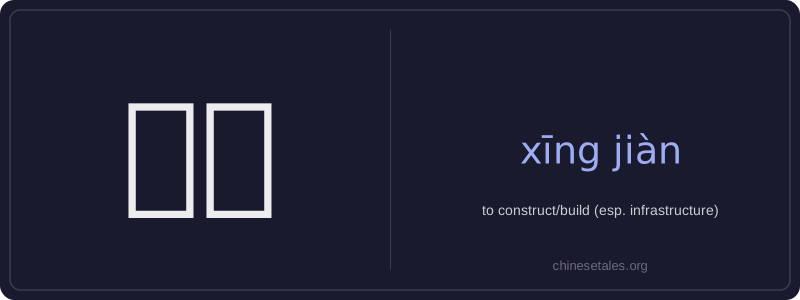
兴建 means 'to construct' or 'to build', especially large-scale infrastructure projects such as roads, bridges, schools, hospitals, or housing developments. It carries a formal, official tone and is commonly used in news reports, government announcements, and planning documents. The character 兴 (xīng) originally means 'to rise', 'to flourish', or 'to initiate', while 建 (jiàn) means 'to build' or 'to establish'. Together, 兴建 emphasizes the initiation and execution of construction — not just physical building, but the launch of a significant development effort.
This verb is almost always transitive and requires an object (e.g., 兴建学校, 兴建地铁). It rarely appears in casual speech; instead, everyday contexts favor simpler verbs like 盖 (gài) or 建造 (jiànzào). 兴建 is frequently paired with words indicating scale, purpose, or location — for example, '新建' (newly built), '规划建设' (planned construction), or '当地' (local area) — underscoring its association with organized, institutional development.
Example Sentences
Related Words
见面
见面 literally means 'see face' — combining 见 (t
后来
Later (hòulái) is an adverb meaning 'afterwards'
背后
背后 literally means 'back + behind' and functions
我的
我的 (wǒ de) is a possessive pronoun meaning 'my'
这么
这么 (zhè me) is an adverb meaning 'so' or 'this
中学
'Zhōngxué' literally combines 'zhōng' (middle)
前面
前面 (qián miàn) literally combines 前 (qián, '
面条
‘面条’ (miàn tiáo) literally means ‘flour str