Word Explanation
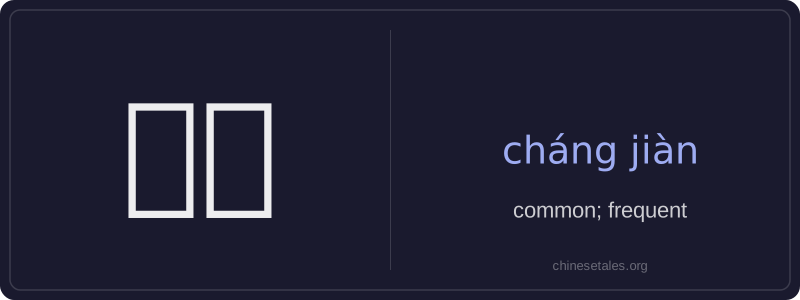
‘常见’ is an adjective meaning 'common' or 'frequent'—describing something that appears regularly or is widely encountered in everyday life. The first character 常 (cháng) means 'often' or 'usual', while 见 (jiàn) means 'to see' or 'to encounter'. Together, they literally convey 'often seen', which has evolved into a fixed compound meaning 'commonly observed' or 'ubiquitous'. It’s used to describe objects, phenomena, behaviors, or conditions that recur frequently in daily experience—not necessarily implying anything positive or negative, just statistical or experiential frequency.
This word is commonly found in descriptive statements, explanations, and observations—especially in spoken and written Mandarin about routine life, health, nature, or social behavior. It often modifies nouns directly (e.g., 常见问题 'common questions') or follows verbs like 是 or 出现 (e.g., 这种现象很常见 'This phenomenon is common'). Unlike the verb 见, 常见 itself is never used as a verb—it functions strictly as an attributive or predicative adjective.
Example Sentences
Related Words
见面
见面 literally means 'see face' — combining 见 (t
后来
Later (hòulái) is an adverb meaning 'afterwards'
背后
背后 literally means 'back + behind' and functions
我的
我的 (wǒ de) is a possessive pronoun meaning 'my'
这么
这么 (zhè me) is an adverb meaning 'so' or 'this
中学
'Zhōngxué' literally combines 'zhōng' (middle)
前面
前面 (qián miàn) literally combines 前 (qián, '
面条
‘面条’ (miàn tiáo) literally means ‘flour str