Word Explanation
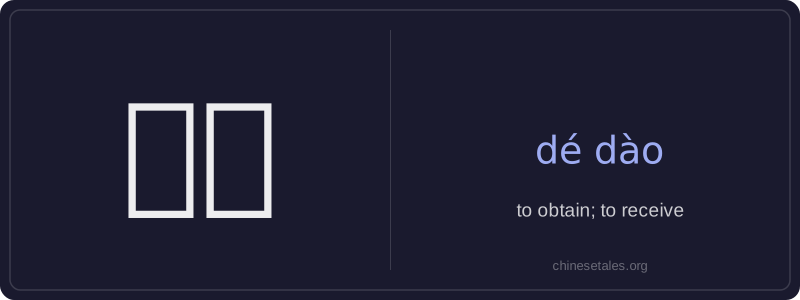
得到 (dé dào) is a common two-character verb meaning 'to obtain' or 'to receive' — something that comes into one's possession or awareness, often as a result of effort, luck, or circumstance. The first character 得 (dé) conveys the idea of gaining or acquiring, while 到 (dào) adds a sense of completion or arrival — together, they emphasize successful acquisition or attainment. It’s neutral in register and widely used in both spoken and written Chinese.
This verb typically takes a direct object (e.g., a gift, information, approval, or results) and does not require aspect particles like 了 to indicate completion — though 了 can be added for emphasis on the change of state. It frequently appears in contexts involving rewards, learning outcomes, official decisions, or personal achievements. Unlike more formal synonyms like 获得 or more colloquial ones like 拿到, 得到 strikes a natural balance between clarity and everyday usability.
Example Sentences
Related Words
中学
'Zhōngxué' literally combines 'zhōng' (middle)
见面
见面 literally means 'see face' — combining 见 (t
后来
Later (hòulái) is an adverb meaning 'afterwards'
背后
背后 literally means 'back + behind' and functions
我的
我的 (wǒ de) is a possessive pronoun meaning 'my'
这么
这么 (zhè me) is an adverb meaning 'so' or 'this
前面
前面 (qián miàn) literally combines 前 (qián, '
面条
‘面条’ (miàn tiáo) literally means ‘flour str