Word Explanation
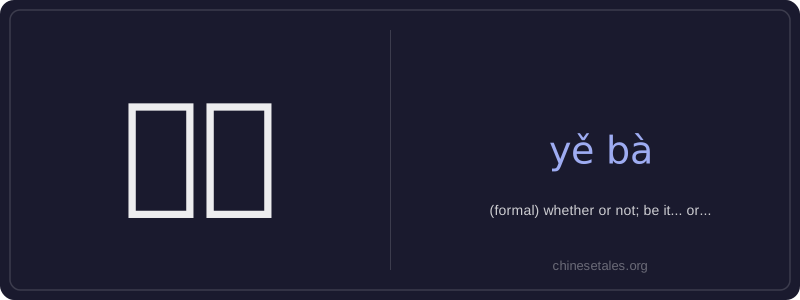
也罢 is a formal conjunction meaning 'whether or not' or 'be it... or...', used to express resignation, indifference, or acceptance of alternatives. The character 也 means 'also' or 'too', conveying inclusion or equivalence, while 罢 (here pronounced bà) functions as a classical particle indicating concession or finality—similar to 'let it be' or 'so be it'. Together, they form a fixed literary expression that softens a contrast or dismisses distinctions between options.
This phrase typically appears after two or more parallel noun phrases, verb phrases, or clauses introduced by '是...还是...' or '...或...', though it may also follow a single option when implying an unspoken alternative. It carries a slightly melancholy, philosophical, or detached tone—common in written Chinese, essays, poetry, and formal speeches—but rarely in casual spoken language. Learners should note it's not interchangeable with colloquial equivalents like '都行' or '随便'.
Example Sentences
Related Words
中学
'Zhōngxué' literally combines 'zhōng' (middle)
见面
见面 literally means 'see face' — combining 见 (t
后来
Later (hòulái) is an adverb meaning 'afterwards'
背后
背后 literally means 'back + behind' and functions
我的
我的 (wǒ de) is a possessive pronoun meaning 'my'
这么
这么 (zhè me) is an adverb meaning 'so' or 'this
前面
前面 (qián miàn) literally combines 前 (qián, '
面条
‘面条’ (miàn tiáo) literally means ‘flour str