Word Explanation
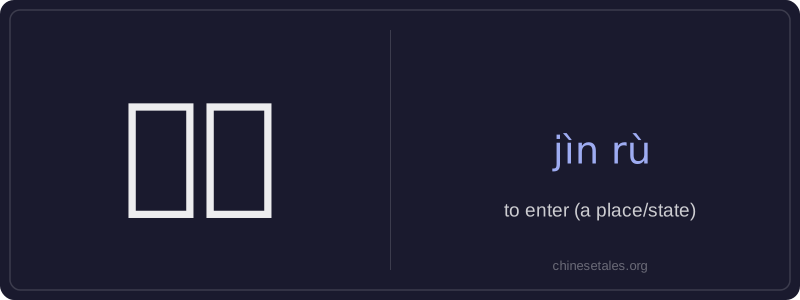
进入 (jìn rù) is a compound verb meaning 'to enter' — literally combining 进 ('to go in, advance') and 入 ('to enter, go into'). It emphasizes the action of crossing a physical or conceptual boundary into a place, state, condition, or phase. Unlike the simpler verb 进 (jìn), which often requires a directional complement like 进来 or 进去, 进入 is more formal and complete on its own, frequently used in written Chinese, news reports, academic texts, and official announcements.
This verb commonly takes nouns denoting locations (e.g., 房间, 会议室, 市场), abstract domains (e.g., 状态, 阶段, 角色), or systems (e.g., 程序, 数据库). It does not take aspect markers like 了 or 过 directly after it unless followed by a result complement or object — for example, 他进入了房间 is natural, but *他进入了了 is incorrect; instead say 他已经进入了房间. It’s rarely used in casual spoken Chinese with concrete, small-scale spaces (e.g., you’d say 我进来了 instead of 我进入了我家).
Example Sentences
Related Words
中学
'Zhōngxué' literally combines 'zhōng' (middle)
见面
见面 literally means 'see face' — combining 见 (t
后来
Later (hòulái) is an adverb meaning 'afterwards'
背后
背后 literally means 'back + behind' and functions
我的
我的 (wǒ de) is a possessive pronoun meaning 'my'
这么
这么 (zhè me) is an adverb meaning 'so' or 'this
前面
前面 (qián miàn) literally combines 前 (qián, '
面条
‘面条’ (miàn tiáo) literally means ‘flour str