Word Explanation
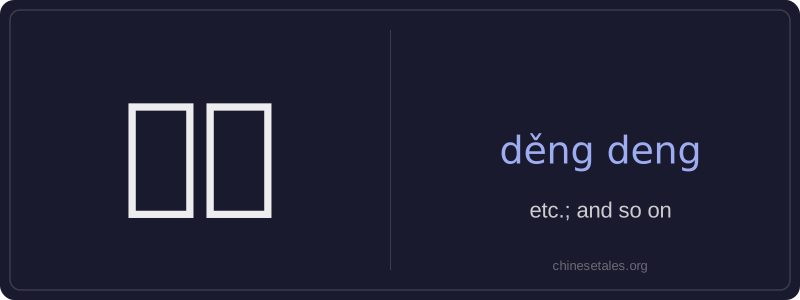
等等 (děng deng) is a noun meaning 'etc.', 'and so on', or 'and others'. Though it consists of two identical characters, the second 等 is toneless in speech — pronounced lightly as 'deng' without a tone mark — signaling its function as a grammatical particle rather than a standalone verb meaning 'to wait'. It’s used to indicate that a list is incomplete, implying there are additional items of the same kind not explicitly named. It often appears at the end of a noun phrase and is common in both spoken and written Chinese, especially in informal or conversational contexts.
The word carries no semantic weight beyond signaling omission; it doesn’t specify how many or what kinds of items follow. Unlike formal equivalents like '諸如此類' (zhū rú cǐ lèi), 等等 is neutral in register and widely accepted in everyday usage — from shopping lists to classroom instructions. It works after nouns, noun phrases, or even verbs when listing actions, but never stands alone as a subject or object without prior context.
Example Sentences
Related Words
见面
见面 literally means 'see face' — combining 见 (t
背后
背后 literally means 'back + behind' and functions
中学
'Zhōngxué' literally combines 'zhōng' (middle)
面条
‘面条’ (miàn tiáo) literally means ‘flour str
后来
Later (hòulái) is an adverb meaning 'afterwards'
我的
我的 (wǒ de) is a possessive pronoun meaning 'my'
这么
这么 (zhè me) is an adverb meaning 'so' or 'this
前面
前面 (qián miàn) literally combines 前 (qián, '