Word Explanation
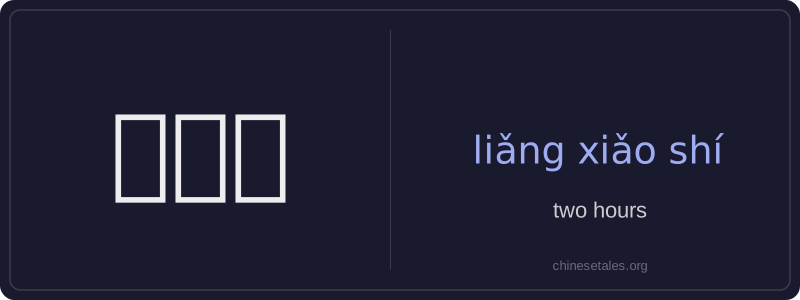
'两小时' literally combines the numeral '两' (liǎng, meaning 'two') with '小时' (xiǎo shí, meaning 'hour'). Unlike '二小时', which is grammatically possible but rarely used for counting time units, '两小时' is the standard, natural way to express 'two hours' in spoken and written Chinese. The character '两' functions here as a measure word-like numeral specifically used before classifiers like '个', '次', '小时', '斤', etc., especially in colloquial contexts.
This phrase is commonly used to indicate duration — for example, when describing how long an activity lasts, how much time remains, or how far apart events are. It frequently appears after verbs like '要' (yào, 'will take'), '花' (huā, 'to spend'), or '等' (děng, 'to wait'), and often follows time prepositions like '在...之后' (after...) or '从...开始' (starting from...). It’s neutral in register and appropriate in both informal conversation and formal writing when referring to elapsed or projected time.
Example Sentences
Related Words
见面
见面 literally means 'see face' — combining 见 (t
背后
背后 literally means 'back + behind' and functions
中学
'Zhōngxué' literally combines 'zhōng' (middle)
面条
‘面条’ (miàn tiáo) literally means ‘flour str
后来
Later (hòulái) is an adverb meaning 'afterwards'
我的
我的 (wǒ de) is a possessive pronoun meaning 'my'
这么
这么 (zhè me) is an adverb meaning 'so' or 'this
前面
前面 (qián miàn) literally combines 前 (qián, '