Word Explanation
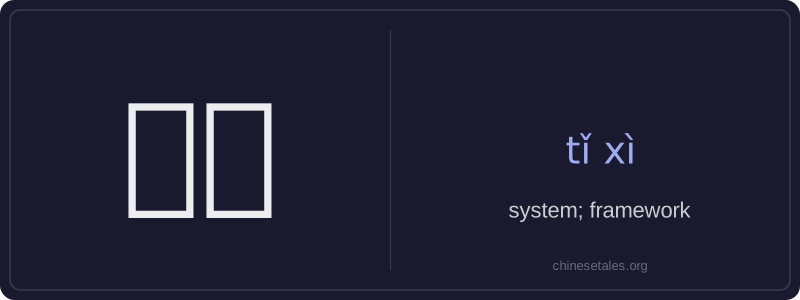
‘体系’ (tǐ xì) is a compound noun meaning 'system' or 'framework' — a structured, organized whole made up of interrelated parts. The first character 体 (tǐ) means 'body', 'entity', or 'substance', suggesting the tangible or conceptual core; the second character 系 (xì) means 'series', 'system', or 'connection', emphasizing relationships and coherence. Together, they convey an integrated structure with internal logic and functional interdependence.
This word is commonly used in formal, academic, or institutional contexts — for example, education systems (教育体系), legal systems (法律体系), ecological systems (生态系统), or even technical frameworks like software architecture. It implies comprehensiveness, hierarchy, and purposeful design, not just a random collection of elements. While often abstract, it can also refer to physical infrastructures (e.g., transportation systems). It rarely appears in casual daily speech but is essential for discussing organization, policy, science, or philosophy.
Example Sentences
Related Words
见面
见面 literally means 'see face' — combining 见 (t
背后
背后 literally means 'back + behind' and functions
中学
'Zhōngxué' literally combines 'zhōng' (middle)
面条
‘面条’ (miàn tiáo) literally means ‘flour str
后来
Later (hòulái) is an adverb meaning 'afterwards'
我的
我的 (wǒ de) is a possessive pronoun meaning 'my'
这么
这么 (zhè me) is an adverb meaning 'so' or 'this
前面
前面 (qián miàn) literally combines 前 (qián, '