Word Explanation
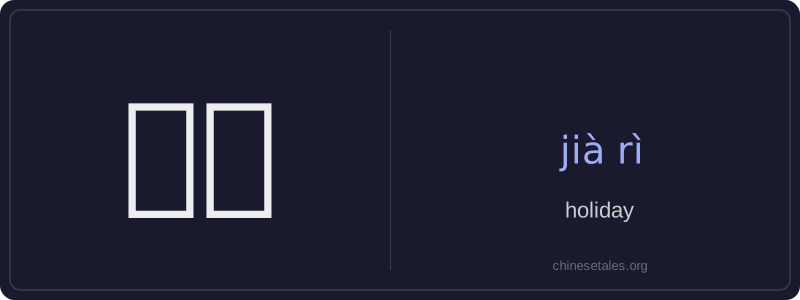
'假日' (jià rì) literally combines '假' (jià), meaning 'leave' or 'time off', and '日' (rì), meaning 'day'. Together, it refers to a day on which people do not work or attend school — a holiday or day off. Unlike '节日' (jié rì), which emphasizes cultural or national celebrations (e.g., Spring Festival), '假日' focuses on the functional aspect: a break from routine obligations. It’s commonly used for statutory holidays (e.g., National Day Holiday), weekends treated as rest days, or personal leave periods.
The term is neutral and widely used in both formal and informal contexts — in government announcements, workplace notices, travel ads, and everyday conversation. It can be singular ('一个假日') or plural ('多个假日'), and often appears with measure words like '个' or time expressions like '国庆假日' (National Day holiday period). While '假日' may overlap with '假期' (jià qī, 'holiday period'), the latter refers to a span of days, whereas '假日' typically denotes individual days or the concept of a day off.
Example Sentences
Related Words
见面
见面 literally means 'see face' — combining 见 (t
背后
背后 literally means 'back + behind' and functions
中学
'Zhōngxué' literally combines 'zhōng' (middle)
面条
‘面条’ (miàn tiáo) literally means ‘flour str
后来
Later (hòulái) is an adverb meaning 'afterwards'
我的
我的 (wǒ de) is a possessive pronoun meaning 'my'
这么
这么 (zhè me) is an adverb meaning 'so' or 'this
前面
前面 (qián miàn) literally combines 前 (qián, '