Word Explanation
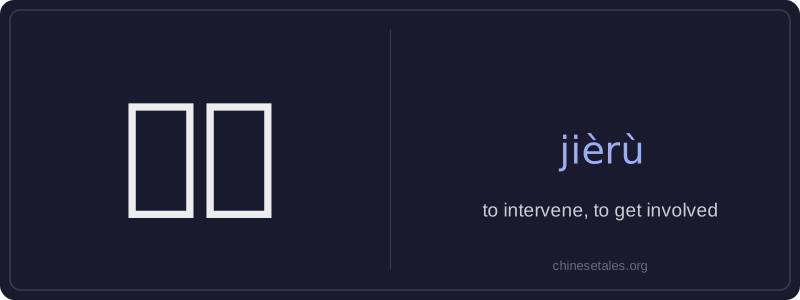
‘介入’ is a verb meaning ‘to intervene’ or ‘to get involved’, typically in a situation where one’s action affects an ongoing process or relationship. The first character, 介 (jiè), originally means ‘to introduce’ or ‘to mediate’, while 入 (rù) means ‘to enter’. Together, they convey the idea of entering into a matter — not passively, but with purpose and influence. It often carries a slightly formal or neutral-to-serious tone, implying active participation that may alter outcomes.
This word is commonly used in professional, social, or institutional contexts — especially in healthcare (e.g., medical intervention), diplomacy, education, or family disputes. Unlike casual terms like 参与 (cānyù, ‘to participate’), 介入 suggests a more direct, potentially decisive role. It can be used reflexively (e.g., 自行介入) or with agents (e.g., 医生介入治疗). While not inherently negative, it may imply overstepping if context lacks legitimacy or consent.
Example Sentences
Related Words
见面
见面 literally means 'see face' — combining 见 (t
背后
背后 literally means 'back + behind' and functions
中学
'Zhōngxué' literally combines 'zhōng' (middle)
面条
‘面条’ (miàn tiáo) literally means ‘flour str
后来
Later (hòulái) is an adverb meaning 'afterwards'
我的
我的 (wǒ de) is a possessive pronoun meaning 'my'
这么
这么 (zhè me) is an adverb meaning 'so' or 'this
前面
前面 (qián miàn) literally combines 前 (qián, '