Word Explanation
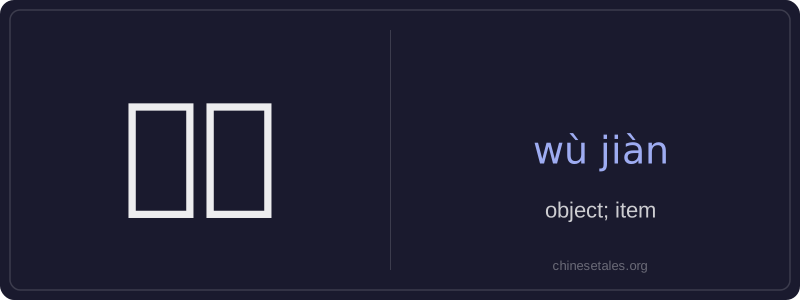
物件 (wù jiàn) is a general, neutral noun meaning 'object' or 'item'—referring to any physical, countable thing, especially one that is small, portable, or handled in daily life. The first character 物 (wù) means 'thing' or 'matter', while 件 (jiàn) is a common measure word for discrete, tangible items; together, they form a compound emphasizing individual, concrete objects rather than abstract concepts or uncountable substances.
This word is frequently used in formal, administrative, or descriptive contexts—such as lost-and-found notices, inventory lists, museum labels, or instructions ('Please check all personal物件'). It carries a slightly more precise and objective tone than the broader term 东西 (dōng xi), and is rarely used for living beings or natural phenomena. While grammatically pluralizable with numerals and measure words (e.g., 三件物件), it’s most often seen in singular or unmarked form when referring to items collectively.
Example Sentences
Related Words
见面
见面 literally means 'see face' — combining 见 (t
背后
背后 literally means 'back + behind' and functions
中学
'Zhōngxué' literally combines 'zhōng' (middle)
面条
‘面条’ (miàn tiáo) literally means ‘flour str
后来
Later (hòulái) is an adverb meaning 'afterwards'
我的
我的 (wǒ de) is a possessive pronoun meaning 'my'
这么
这么 (zhè me) is an adverb meaning 'so' or 'this
前面
前面 (qián miàn) literally combines 前 (qián, '