Word Explanation
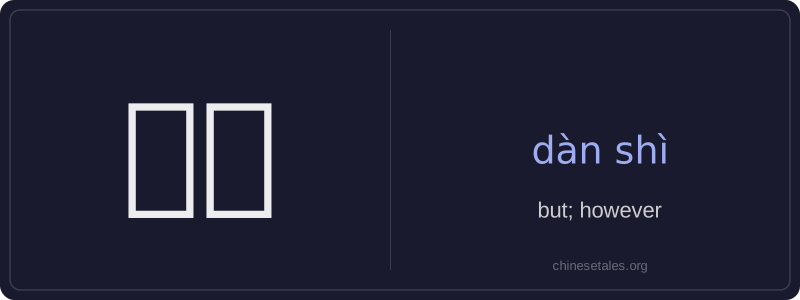
但是 (dàn shì) is a coordinating conjunction meaning 'but' or 'however'. It connects two contrasting ideas or clauses — the first clause presents a fact, expectation, or situation, and the second introduces an unexpected or opposing detail. Though composed of two characters — 但 (dàn), meaning 'only' or 'merely', and 是 (shì), meaning 'is' or 'to be' — together they function as a single grammatical unit with no literal connection to their individual meanings. It is neutral in register and widely used in both spoken and written Chinese.
But unlike English 'but', 但是 typically appears at the beginning of the second clause (not mid-sentence), and it must be followed by a complete clause — never just a noun or adjective alone. It often follows a comma when joining independent clauses, and it’s frequently paired with a contrastive adverb like 也 (yě, 'also') or 还是 (hái shì, 'still') in the second clause to strengthen the contrast.
Example Sentences
Related Words
见面
见面 literally means 'see face' — combining 见 (t
背后
背后 literally means 'back + behind' and functions
中学
'Zhōngxué' literally combines 'zhōng' (middle)
面条
‘面条’ (miàn tiáo) literally means ‘flour str
后来
Later (hòulái) is an adverb meaning 'afterwards'
我的
我的 (wǒ de) is a possessive pronoun meaning 'my'
这么
这么 (zhè me) is an adverb meaning 'so' or 'this
前面
前面 (qián miàn) literally combines 前 (qián, '