Word Explanation
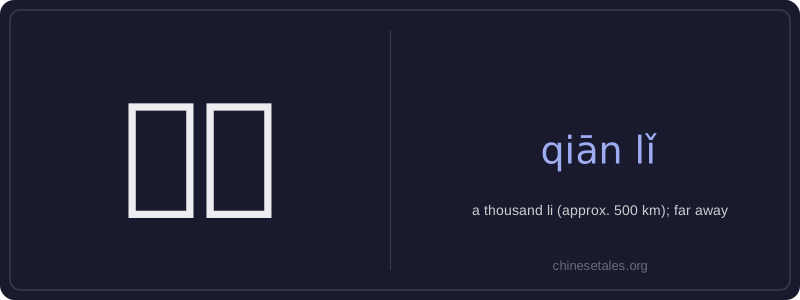
‘千里’ literally means ‘a thousand li’, where 千 (qiān) means ‘one thousand’ and 里 (lǐ) is a traditional Chinese unit of distance—approximately 500 meters—so ‘a thousand li’ equals about 500 kilometers. Though rarely used as a precise measurement today, 千里 functions idiomatically to express great physical distance or remoteness, often evoking poetic or literary imagery of vast separation.
The term appears frequently in classical poetry, proverbs, and modern expressions emphasizing travel, longing, or effort over long distances. It carries a slightly formal or literary tone and is commonly found in set phrases like 千里马 (qiān lǐ mǎ, ‘thousand-li horse’, meaning an exceptional talent) or 千里迢迢 (qiān lǐ tiáo tiáo, ‘from afar’). Unlike simple numerals, 千里 is not used for counting or arithmetic but rather as a fixed, figurative noun meaning ‘faraway place’ or ‘great distance’.
Example Sentences
Related Words
见面
见面 literally means 'see face' — combining 见 (t
背后
背后 literally means 'back + behind' and functions
中学
'Zhōngxué' literally combines 'zhōng' (middle)
面条
‘面条’ (miàn tiáo) literally means ‘flour str
后来
Later (hòulái) is an adverb meaning 'afterwards'
我的
我的 (wǒ de) is a possessive pronoun meaning 'my'
这么
这么 (zhè me) is an adverb meaning 'so' or 'this
前面
前面 (qián miàn) literally combines 前 (qián, '